Written & Directed by: Andrew Paquin Full credits at IMDb
Open House, an irredeemably nasty home-invasion film, revels in throat slittings and belt beatings. To what end? None, beyond that its repugnance reflects its emetic sexual politics. The debut for director Andrew Paquin, whose highest-profile credit to date was a producer on Renee Zellweger rom-com New in Town, the movie serves as a cautionary tale about the sexual self-realization of the female. The Hurt Locker’s Brian Geraghty stars as David, the unsmiling and doe-eyed facilitator of black widow Lila (Tricia Helfer), who likes to be secretly filmed fucking her prey before (literally) stabbing it in the back. (This might seem like a statement on voyeurism, but it’s not.) The couple, the nature of whose relationship remains ambiguous for much of the movie, has taken over the on-the-market house belonging to Alice (Rachel Blanchard), who spends the bulk of the movie held captive in a basement crawl space, like a secret pet the boyish David is hiding from his stern mommy. Though he was supposed to, David has kindly neglected to kill her, in contrast to her quickly dispatched biffle (played by director’s sister Anna; brother-in-law to-be Stephen Moyer also turns up for a quick death—it’s true[ly] blood[y]!)
Keep reading this dispatch from The Tribeca Film Festival at The L Magazine
Directed by Steve Pink Written by Josh Heald, Sean Anders and John Morris Full credits at IMDb
Hot Tub Time Machine—the silliest literal-movie-title since Snakes on a Plane—early on references a few recent and retarded Boy-Bonding movies: Wild Hogs directly, The Hangover allusively, with the suggestion that the main characters “steal a police car”. But the movie—about three middle-aged friends and (why not?) one college-ager who travel back to the 1980s via magic Jacuzzi—never approaches, and hardly tries to, the fun-loving camaraderie of those (awful) men-behaving-badly comedies. Were it not for a few accusations of homosexuality, a skiing accident and some projectile vomit, Hot Tub Time Machine wouldn’t qualify as a comedy at all. It’s actually really sad.
Rob Corddry, Craig Robinson and John Cusack—getting Cusack in an ‘80s nostalgia movie is like landing Malkovich for Being John Malkovich—play the movie’s heroes, whom I expected to be middle-aged men disillusioned with their present condition, yearning for the glory of their youths not unlike Matthew Perry in 17 Again, another movie that makes no effort to explain its time-travel mechanisms. But there’re no fond remembrances to be found in Hot Tub Time Machine: in the present, Corddry is an epically angry and suicidal dickhead; Cusack is a lonely hangdog; Robinson is an exhausted cuckold. (Since this is a movie about time travel and the '80s, Crispin Glover also turns up, amazingly stripped of any eccentricity for the second time this year.) The moment the characters wind up back in 1986, they’re just as depressed as they already were.
Thanks to the (il)logic of the time-shifting conceit, the characters are simply forced to relive the humiliations of their youth, to re-confront past emotional pains. (Ignore the brief attempts to grapple with free will vs. determinism.) Their miserable present-day lives are the results of bad choices that were already in motion 20 years in the past. “We had Reagan and AIDS,” Cusack says, summing up the decade. “Let’s get the fuck out of here.” Pain permeates almost every line and action in the movie—even the “happy ending” merely implies that money whitewashes suffering, if not buys happiness—but director Pink seems totally oblivious to it, treating the movie as a wacky comic throwback; it’s like he can see the actors in front his camera, but can’t hear what they’re saying. As such, the movie’s tonally fucked, neither funny like it wants to be nor depressing like it is on paper. Grade: C
Written & Directed by Maren Ade Full credits at IMDb
Aside from its Godard-y opening credits and the Eden-ness of its sun-splashed Sardinian setting, Everyone Else (Alle Anderen), so Bergman-esque it could warrant the alternate title Scenes from a Coupling, isn’t particularly cinematic—it’s theatrical. Not only are its one-on-one scenes predominantly dialogue-driven, but it’s a through-and-through actor’s piece: two hours of talk and small, subtext-revealing gestures. Chris (Lars Eidinger) and Gitti (Birgit Minichmayr) constitute the young, holidaying German couple around whom the film revolves; he’s a taciturn moodyman, she’s his loquacious girlfriend. With a forthrightness at odds with Swanberg and his ilk’s hemming hawers, the two engage in conversations that swerve from playful teasing to curt putdowns; their idylls curdle into spats born of selfishness that are soon forgotten. Or, are they? He becomes embarrassed of their private jokes and yearns for a “normal” girl; she wants a man who loves her, who doesn’t respond to her intimate confessions of affection with a passionate but promiseless kiss. The film unfolds in two acts, a love's rise and fall, though it’s easy to spot the fissures in the relationship throughout: you see it in certain glances, or hear it in certain inflections; you just know these kids ain’t gonna make it. The film's genius lies in its recognition of a cumulative effect: every scene builds on the last in not-so-obvious ways and leaves you thinking, “ah, yes! Perfect,” wincing with discomfort at the duo's subtle interplay. Everyone Else is so expertly and casually performed you’re left wondering: is its totally-nailed portrait of a relationship the result of brilliant scripting? Or carefully edited improvisations? To whom do we deliver the accolades? Grade: B+
Written & Directed by: Mohammad Rasoulof Full credits at IMDb
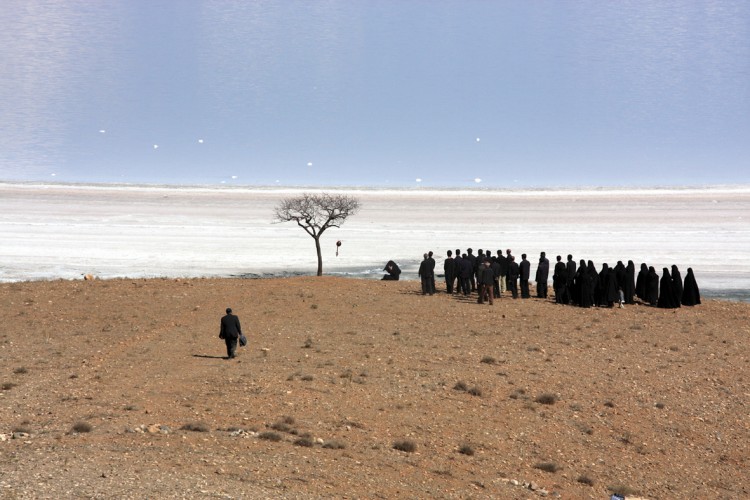
The White Meadows, a stinging neo-realist fable, looks like it’s set on an ashen, alien salt-planet of milky seas, white-sand deserts, caves like slavering animal mouths, and beaches so blank they must be purgatorial. But the allegorical criticisms that emerge from this lunar, lacunal landscape are clearly aimed at the real world—an impression buttressed by the news that director Rasoulof was arrested in Iran this March as part of a post-election program of intimidation.
Rahmat (Hasan Pourshirazi) sails the pearly pale seas of Lake Urmia, hopping between islands in his rickety rowboat, collecting the locals’ tears in a playset-sized pitcher. And there are no shortages of tears...
Keep reading this dispatch from the 2010 Tribeca Film Festival at The L Magazine
The Disappearance of Alice Creed Directed by J Blakeson This darkly comic abduction-thriller is so matter-of-fact in its details it could function as a how-to: buy this much sound-proofing, this many cell phones, and these kinds of locks if you want to collect the ransom on a rich man's grown daughter. You've seen kidnapping movies before, yeah? But this one, so tightly contained it could be a play, mixes its cliches with upending twists: exploitation turns into empowerment, machismo into homosexuality. It's at times hilariously surprising, but the narrative zags amount to little more than stunt plotting, hustling to sucker-punch a been-there audience. Would that Blakeson had worked as hard to overcome the film's pervasive nastiness or cool misogyny: just because a movie leaves the last girl standing doesn't mean it has undone the beatings and humiliations that led up to it. Co-starring Eddie Marsan, who played the driving instructor in Happy-Go-Lucky.
Metropia Directed by Tarik Saleh This dystopic, animated technonoir traces the development of an ordinarily unhappy everyman into system-smashing revolutionary in a post-peak oil future: Europe—portrayed as smog-shrouded industrial ruins—has been united by a pan-continental super-subway; bicycle riding is illegal. Also, corporations are using shampoo to control minds and the Metro can read your thoughts. Cast in subterranean grey, the animation is very PlayStation, blending hyperreal design with the skittery motion of a South Park episode. And it's appropriate: the herky-jerky, gloomy-futurist aesthetic is as disquieting as the movie's advertising age conspiracy and surveillance state nightmare.
Micmacs Directed by Jean-Pierre Jeunet Jeunet, of Amelie renown/infamy, delivers another entry in his career-long series of grating Live-Action Cartoons For 11-Year-Olds. This one concerns a gang of junkyard irregulars, consciously modeled on Toy Story's chestful of oddballs, righteously warring with weapons manufacturers. Its in-your-face whimsy, Luhrmann-esque tone, and goofy ethic and aesthetic make it triply hard to take seriously its political message about the cruel indifference of arms dealers, their implicit culpability in murder. Jeunet is not without virtues—the film is wordless when it can be, and uses an old Max Steiner score to great effect—but Micmacs still comes off like Paul Blart trying to pass as Art.
Possessed Directed by Lee Yong-ju Lee cut his teeth as an assistant director on Bong Joon-Ho's Memories of Murder, but his directorial debut shows he learned little from the Korean master: rather than reinvent a genre, Lee cranks out a formulaic blend of two—K-Horror and police procedural—that's efficient in its jolts but less than convincing in its assault on religious devotions, from superstitious shamanist rituals to Christian fanaticism. (The Korean title transliterates as Hell of the Non-Believers.) Be sure to bring the outrage towards Organized Religion that you cultivated as an adolescent; you'll be rolling your eyes without it.
Sentimental Engine Slayer Directed by Omar Rodriguez-Lopez "El Paso" is credited alongside the actors during the end credits, because this aggressively artsy fever dream is as much a portrait of a place as it is of a person. As unstable as its baby-faced hero (34-year-old Mars Volta guitarist Lopez), the movie is a hallucinatory, logic-less tour through desert roads and houseparties that charts the insecure and frequently violent fantasies of the possibly homosexual virgin: sex, sex, humiliation, retributive violence, and sex. Though essentially about (maybe?) getting a kid laid, it's less Superbad than a Mexican-American variation of Loren Cass, with sex replacing race-violence; or, it's like Donnie Darko without wormholes or rabbitmen.
Read more at The L Magazine's Tribeca Film Festival Preview
Written & Directed by: David Kittredge Full credits at IMDb
"You like to watch?" Yeah, Pornography, kind of pretentious, is one of those movies. Kind of amazing, too, it's also the Citizen Kane of gay porn ghost stories. Told in three distinct and uroboric acts, it revolves around the years-ago disappearance of a male-porn star (Jared Grey) and its present-day effect on a Brooklyn writer (Matthew Montgomery) and an L.A. adult film icon-turned-adult-film director (Pete Scherer). The first is working on a Social History of homosexual pornography, the other a screenplay that looks a lot like the first third of the movie we're watching: that is, Pornography's last act concerns the creation of its first—by a character with a tangential role in the second—which might explain why, for its first few reels, it self-consciously mimics the stilted line readings, hard-working dialogue and contrived set-ups of a dirty movie refigured as straight-to-video horror-noir.
Directed by: Agnieszka Wojtowicz-Vosloo Written by: Agnieszka Wojtowicz-Vosloo, Paul Vosloo & Jakub Korolczuk Full credits at IMDb
Christina Ricci, looking at her pale, putrefying body in a mirror, asks, "Why do I look like a corpse?" "Because you are a corpse," her undertaker answers. After.Life is so funny! But, sigh, if only somebody had told the director; Agnieszka Wojtowicz-Vosloo plays that comic exchange for tears instead of laughs. Throughout her feature debut she repeatedly tries to wring significance from a script (which she wrote with Paul Vosloo and Jakub Korolczuk) that's inherently full of conspicuous camp: A policeman turns up at the morgue to peek under the covers and ogle corpse-tits; Justin Long beats up a little kid in an elementary school hallway. And she wants us to gasp in horror?
Directed by: Nash Edgerton Written by: Joel Edgerton & Matthew Dabner Full credits at IMDb
A gripping—if nothing else—neo-neo-noir, The Square offers no fresh insights into genre or humanity. But what’s wrong with just spinning a good yarn once in a while? The debut feature of recently Times-profiled Blue-Tongue Productions, a loosely knit, Australia-based moviemaking-collective, the film offers N.Y. audiences their first chance to see Joel Edgerton (who also co-wrote the script, with Matthew Dabner) since he yowled for Stella in BAM’s Streetcar last December. He and the rest of the cast work to humanize familiar archetypes: the graying hangdog, the irascible cuckold, the spacey girlfriend, the femme fatale. Everything about The Square feels, ostensibly, as familiar as those characters: following a Postman-esque narrative, it depicts an affair between Ray (David Roberts) and Carla (Claire van der Boom), who struggle to raise cash illicitly so they can run away together. But Best Laid Plans etc. etc. etc.
Directed by: Daryl Wein Written by: Peter Duchan, Zoe Lister Jones & Daryl Wein Full credits at IMDb
The most significant emotional experience of a young man's life is often his first big break-up, which might explain why we see so many separation movies starring twentysomethings—"my specific heartbreaking story must be told!" It's particularly the case in the indies, where emerging artists are encouraged to indulge their Deepest Feelings. On the more mainstream, and shallower, side, there was last year's (500) Days of Summer; on the indier, sincerer side, there's the alternately endearing and exhausting Breaking Upwards. Both deal with unremarkable Millennials working through unremarkable problems. The question is, do they do so remarkably?
Well, in the case of Breaking Upwards—sort of. (For the former—no way!)
Directed by: Tim Burton Written by: Linda Woolverton Full credits at IMDb
Counterintuitively, if not paradoxically, CGI has had a crippling effect on Tim Burton’s imagination. Computers, you’d think, would liberate visionaries from the limitations of the real—to make the impossible possible—but often it’s those very limits that fuel the artist’s creativity. Computers eliminate the need for resourcefulness, which serves as many artists’ motivating force—Burton in particular. As anyone who’s taken a stroll through his MoMA show knows, he’s an expert craftsman and a sketchbooker of vivid inventiveness. But left to the limitless possibilities of computer animation, he proves a bland imagineer. Ones and zeroes ain’t his medium.
His Alice in Wonderland, better titled Alice’s Re-Adventures in Underland (because Burton is so Dark even his wonderlands are stripped of wonder!), is dreary, ugly and lifeless: it’s gray, despite its colors; flat, despite its three dimensions. It’s so sucked of vim that even Crispin Glover, usually irrepressibly idiosyncratic, seems diminished, reduced to the rank of just another Hollywood supporting man. Seriously—how do you make Crispin Glover dull? Burton’s mode here is predictable fantasticality, smothered by special-glasses layers of perspective. The film was shot in two dimensions and retrofitted in three—big mistake! The new technology works best in giving still shots a depth of field of which cinematographers once could only dream. But Burton’s camera doesn’t stop moving. Without planning for those extra dimensions, the action blurs, rendered as incoherent as a Christopher Nolan fight sequence.
The unimpressive, garishly dull, dizzyingly busy visuals parallel, rather than make up for (as in Avatar), the Planet of the Apes-level, by-committee screenwriting. (Screenwriter Woolverton cut her teeth on several second-Golden-Age Disney scripts.) Alice (Mia Wasikowska), here 20 years-old, is an anachronistically independent young lady who escapes her arranged-engagement-to-a-weasel proposal-ceremony (he is not literally a weasel) by falling into a hole underneath a tree; the portal, something of a birth canal, takes her to the colorless Underland, where a ragtag team of talking animals, misfits, fat heads and dissipating Cheshires is plotting to overthrow the hydrocephalic White Queen, played by Tilda Swinton Red Queen, played by Burton’s wife and muse Helena Bonham Carter, who delivers her requisite “off with their heads!” with gusto. Though pale as raw chalk—@TimBurton: Ricci 2 old? LOL—Alice’s wanness can’t compete with the Krusty-painted face of the Mad Hatter, played by Johnny Depp who, slipping in and out of a brogue, tries only to keep himself amused, like a child playing by himself in a corner.
Burton comes off like something of a lonely child here, too, exiled from the schoolyard for punishing his playmates with torpid adaptations of their favorite adventurebooks. Is it movies like this that turn kids off to reading? Modern, English literary classics—like, say, Charlie and The Chocolate Factory—have not proved a good fit for Burton’s crassly commercial sensibilities when he’s in blockbuster mode (which seems, like, all the time), not least in the way that, in trying to add humanzing backstories to classic characters, he pushes the films way off track. At the end, Alice avoids the unattractive marriage and is offered, instead, to sail with the English to uncharted China, an opportunity for the adventure she has long been denied. Oh, so she’s off to start the Opium Wars? Hoo…ray? Grade: C-
Written & Directed by: Jessica Hausner Full credits at IMDb
Is God good, or is He all-powerful? That’s the driving question—because he can’t be both!—behind Lourdes, a thoughtful, patient and painful meditation on the role of the divine in a miserable and unjust world of cripples and empty religious optimism. Set in the title city, a “touristy” site where the Virgin once appeared to Saint Bernadette (better known as Jennifer Jones), the film takes place over the course of a typical pilgrimage, during which the bemaladied have a full itinerary of visits to potential miracle spots: a sacred stone, blessed springs, a gilded church. A Greek chorus of old ladies gossips about the last person to be healed miraculously and about who could possibly be next. Visitors can only hope it will be them.
Hope seems to be the main target of Lourdes’ mordancy: of all the afflictions to afflict the afflicted, it comes across as the cruelest, more than any spine-paralyzing bug. Even if miracles do actually exist, aren’t they inherently unjust? If God has the power to cure one of us, why wouldn’t he cure all of us? If one person is worthy of a miracle, are the rest of us unworthy? Why? But hope persists because it, and the faith healing as which it manifests, has become an industry, exploited by priests and their higher-ups (to say nothing of a certain president). Institutional corruption is subtly suggested on the film’s periphery: card-playing clergy, flirtatious nurses and gaudy gift shops fill the spaces in Lourdes not occupied by the miracle seeking. The regal church leaders don’t even have the time to bless every un-well visitor who has trekked to town, genuflecting for godly mercy. To cover up its shortcomings, Catholicism (not unlike modern medicine) turns to blame the fetishized victim instead, suggesting that those in wheelchairs stop asking God to heal their bodies and work on healing their own souls: after all, isn’t their infirmity a sort of gift, since it gives them a unique perspective on their life? Oh, don’t make me vomit!
Lourdes is theologically scathing in the questions it raises, but not in the way it raises them. Patiently rolling from place to place—scene to scene, point to moral point—like the wheelchaired pilgrims who occupy its frames, Lourdes (rhymes with “gourd”) starts with the camera perched on high, but slowly, to the ethereal accompaniment of Schubert, lowers to earth, to a man’s-eye level; this isn’t a movie about God’s grace, but about the men who pretend to guard and administer it. As immobile as our heroine, the camera cuts and moves rarely, matter-of-factly depicting paralysis: the spoon-feedings, the liftings into bed. Our guide through this world of rituals both religious and paralytic is Christine (Sylvie Testud), a kind, generally positive, sclerotic woman in a wheelchair. Testud is extraordinary: hope creeps into her face as she brushes the holy rock, and embarrassment at such optimism floods over her immediately after, her visage quickly resettling into its usual contortion of contained fear, exasperation, and hints of jealousy (toward all the able-bodied youths around her), concealed beneath a polite veneer. Like her face, the film is powerful for what it suggests rather than what it stresses, for the way Hausner lets the criticisms creep up from the margins. Lourdes raises richly complex theological quandaries. It isn’t didactic—but it’s devastating, in its quiet, graceful way. Grade: A-
Written & Directed by: Jean-Pierre & Luc Dardenne Full credits at IMDb
Every scene in Lorna’s Silence (Le Silence de Lorna), a devastating depiction of Western decadence, suggests the point of view of a fly on the wall, or at least a nosy neighbor. But that naturalism is illusory. Though it might feel like Realism, like you’ve just been dumped into la vie de Lorna—watching phone calls, bank visits, work-shifts, preparations for bed—the scenes’ tiny details build to a broader and culturally critical portrait, like the confab with a Yellow Page’s rep in Gus Van Sant’s Last Days. It’s all been meticulously plotted. And just as meticulously scrubbed of any evidence to prove it.
An Albanian national, the title character (Arta Dobroshi) works as a laundress and moonlights as a wife: she marries first for Belgian citizenship, then for extra cash (someone marries her for citizenship) so she and her boyfriend can open that modest snack stand they’ve been dreaming of. Her life of modest crimes requires a certain coldness of character, but Lorna boasts a natural decency that proves her downfall. She goes above and beyond her duties as hired-bride trying to help her green-card husband (Jérémie Renier, a scrawny, veiny, itchy, shaky junkie on the withdraw) from reverting to his addiction; she even bloodies herself in a tricky attempt to save his life. Failing, she becomes complicit in murder.
The Dardennes, eschewing explosive or exploitative melodramatics, omit any bloodletting from the screen, leaving visible only the stress and pain of the everyday hustle. But stress and guilt press down on Lorna, ultimately driving her understatedly mad. It’s an unsettling picture of capitalistic impulses gone crazy, of a culture wherein, for a sackful of Euros, marriage is auctionable, life expendable, babies abortable. (The Bros. Dardennes’ last film, L’Enfant, covered similar territory: it focused on the black-market sale of a newborn.) Is this the cost of Westernization? What’s the solution? The film’s finale suggests that we go back to the starting point and try again: it ends in the forest, a state of nature as far away as possible from the cultural corruption of capitalism and its guns. Grade: A-