19 March 2010

Shutter Island

Directed by Martin Scorsese
Written by Laeta Kalogridis
Full credits at IMDb

Over the last decade, since the wildly undervalued Bringing Out the Dead, Martin Scorsese has consistently disappointed, his features (Shine a Light excepted) feeling less like the work of the man himself than an imitator—and a poor one at that. He became the Old Master pushing factory line prestige, baiting the Academy for the Oscar long deserved and denied. Now that it finally gave him one, he can get back to having fun—to making good movies, if not substantive ones. Shutter Island doesn’t have the sort of pretensions-to-Best-Picture that accompanied Gangs of New York through The Departed: it’s upfront kitsch and old-fashioned fun, combining a lifelong love of classic cinema with an unabashed B-movie élan, trophies be damned. (Which might explain why the movie’s release date got pushed from awards season ’09 to this year’s dumping grounds.)

On the ferry to the titular isle, which houses an asylum and juts out of the harbor like King Kong’s hideaway, Leonardo DiCaprio and Mark Ruffalo stand against a conspicuously rear-projected gray sky, conversing in mismatched edits. Scorsese’s long-time editor Thelma Schoonmaker has famously said, perhaps apocryphally, that “matching is for pussies,” but the purposefully sloppy shots not only pay tribute to a grindier past but create a sense of unease, helped along by the martial score and the fog on loan from Hammer Studios. For the first hour anyway, you’re not supposed to be taking this creepy cheese too seriously; when a ship captain warns that “a storm’s comin’,” and DiCaprio notes that, “what I’m doin’, it’s not exactly by the book,” how could you be expected to? Especially with all the Rain! Thunderrr! And Striiiiings! that accompany images of a forbidden ward, ominous caves, and an off-limits lighthouse. I wonder if each will be visited in due time?

Set in Bah-stin hah-bah circa fifty-faw, Shutter Island casts DiCaprio, keeping his Departed accent, as a detective investigating a (literal) locked room mystery: a woman who drowned her children (the film uses fire and water like Hitchcock uses red and green in Vertigo) has escaped from her cell, without her shoes or a trace. Ruffalo is his partner; Ben Kingsley, in The Christopher Lee Role, plays the pipe-fondling doke-tuh that runs the facility; and Max von Sydow—whose appearance should clue audience members into the Hour of the Wolf allusions to follow—is Kingsley’s Karloff-like sidekick, a fellow doctor and the requisite Kraut, cheerily chewing-up his dialogue. Speaking of Germans and conspicuous camp, how about some flashbacks to the liberation of the concentration camps?

Wait, what? Ah, yes, the monstrosities of Dachau will come to microcosmically reflect DiCaprio’s own post-war past, also marked by unfathomable savagery but on a non-systemic scale. Knowing something we don’t, Leo seems from the first frame to be taking the material a lot more serious than any other actor or crew member, but the movie eventually catches up with him—Scorsese’s talent is evident in the way he slips comfortably between tones—starting with glimpses of a Nazi with his cheek blown off bleeding to death on a floor, his ice-crusted victims stacked outside in the snow. Are Nazi-style experiments now occurring on American soil? Is the O.S.S. involved? H.U.A.C.?

Red herrings galore emerge as Shutter Island moves into more hallucinatory territory that’s also increasingly gruesome, not only in its remembered historical atrocities but in its blood-soaked nightmares; the movie evokes Bruce Wayne battling the Scarecrow, as frames swimming in fluttering objects—ashes, paper, snowflakes, raindrops—suggest the fog not only of memory but of consciousness itself. The film even makes a sojourn into the aesthetic realm of torture porn, with stone tunnels that open into vast hangars (that forbidden ward!), soaked in leaky rainwater and illuminated by single bare light bulbs whose filaments have a habit of exploding. Shutter Island straddles the divide between horror movies old and new, serving as an after-the-fact through-line.

It fails, though, to become a great horror movie because it lacks any convincing subtext, even a tenuous one. It poses its Big Moral Question near the end: is it better to live as a monster, or die a good man? This, of course, is one of those pseudo-moral questions that novelists and screenwriters like to invent, and Scorsese thankfully doesn’t spend a lot time pretending to examine it. He’s too busy reveling in the schlock, and untangling the complexities of the script (based on Dennis Lehane’s novel). The convoluted conspiracies that DiCaprio uncovers obscure the movie’s larger points, suggesting that maybe it doesn’t really have any. No serious ones, anyway, though the film does present a world so barbaric it’s psychotic, a world of H-bombs, Holocausts, and filicide, a world of competing violences and no surviving moral order. And in such a crazy world, who’s really crazy? Huh? It certainly wouldn’t seem to be the people safely tucked away on a remote island. Grade: B+


Watch the trailer:

Making Plans for Lena

Directed by: Christophe Honoré
Written by: Geneviève Brisac & Christophe Honoré

Dysfunctional-family dramas have become as French as tarte aux pommes, from Arnaud Desplechin’s A Christmas Tale and Michel Gondry’s The Thorn in the Heart to Christophe Honoré’s latest, Making Plans for Lena (Non Ma Fille, Tu N'iras pas Danser)...After filming three movies in his homeland’s capital, what he’s taken to calling his “Paris Trilogy” [this, this, and this] Honoré escapes the city for the countryside; shooting with a pale palette, under gray skies and palpably, perpetually damp air, Honoré fashions his Margot at the Wedding, though unlike Noah Baumbach he finds quiet flashes of grace amid the harried realism of strained family relations.

Keep reading at The L Magazine


Watch the (French) trailer:

Vincere

Directed by: Marco Bellocchio
Written by: Marco Bellocchio & Daniela Ceselli
Full credits at IMDb

Humanizing portraits of WWII's larger-than-life villains appear on-screen regularly these days, but rarely so sexily: when was the last time the movies treated us to a glimpse of Hitler or Hirohito's member, as Vincere exposes Il Duce's dangler? A fiery melodrama that devolves into an overlong biopic, the high-pitched, epically soundtracked film posits Mussolini (a brooding and excitable Filippo Timi) not as a bad man of history so much as a bad man, period; it's less concerned with his crimes against humanity than against one human, his devoted secret-wife Ida Dalser (Giovanna Mezzogiorno), who gave the pre-dictator her body and bank account, then bore him a baby, just so he could deny her, have her arrested, beaten, stripped of her son and spirited to a series of asylums, where she died. The title means "To Win."

Keep reading at The L Magazine


Watch the trailer:

City Island

Written & Directed by: Raymond De Felitta
Full credits at IMDb

There's a lot in City Island to roll your eyes about, so much that it's a cinema miracle the movie should be so ultimately likable. For starters, it's packed with crazy plot contrivances and supporting characters straight out of creative writing class assignments—people to talk to, full of wisdom, to serve as catalysts to revelation. Writer-director De Felitta conspicuously admires Woody Allen, even borrowing (crassly) Manhattan's 59th St. Bridge moneyshot. But it's his stated appreciation for James L. Brooks that shows through: the movie's facility, and silly musical cues, come more from classic television than Hannah and Her Sisters. And yet, the movie sports a low-rent loveliness. City Island is this generation's Moonstruck, minus all the Academy Awards I'm sure, with its Italian-American ethnic caricatures and, most of all, its expert comic performances, which successfully walk that fine line between exaggerated and over-the-top. 


Keep reading at The L Magazine


Watch the trailer:

17 March 2010

The Thorn in the Heart

Written & Directed by: Michel Gondry
Full credits at IMDb

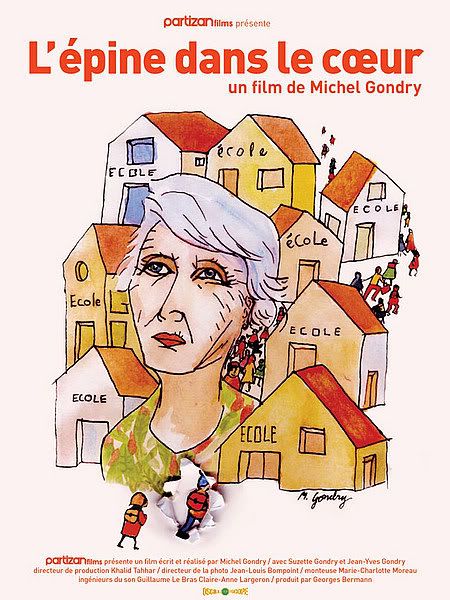
Michel Gondry’s last few films have concerned communities engaged in creation, from Block Party’s Bed Stuy hip-hop hootenanny to Be Kind Rewind’s inner-city indie cinema. In his latest, the non-fiction The Thorn in the Heart (L’Épine dans le Coeur), playing as part of the Rendezvous with French Cinema series, he finds yet another to document. But this time, the community’s creation is the community itself: it’s his family. And, they’re making a movie together.

Gondry’s doc centers on his aunt, Suzette, a septuagenarian in good health and spirits, and follows as she and others revisit the events (figuratively) and locales (literally) from her life, like the countryside écoles where she once taught, many now reduced to rubble. (Those serve as visual demonstrations of the passage of time and the fragility of the material—that is, they’re poignant.) Her life includes minor intersections with French history—Algerian immigrants!—and Gondry tells her story with characteristic whimsy: shots of HO-scale trains to suggest geographic movement; tongue-in-cheek recreations of minor comedic moments that the camera missed; playful experiments with children and special effects; and precious soundtracking.

Keep reading at The L Magazine.


Watch a clip:

10 March 2010

Children of Invention

Written & Directed by: Tze Chun
Full credits at IMDb

Suffering little kids, especially those who lose one or both parents and must depend on the strong, interdependent bond they've developed with each other, are an offensively manipulative narrative device—almost as bad as a murdered dog. So, any movie that centers on such characters has to work extra hard to avoid collapsing into cheap sentimentality. And Children of Invention, the feature debut of writer-director Chun, doesn't work hard enough. Cindy Cheung stars as Elaine Cheng, a single mom hustling in double time in the suburbs outside of Boston to provide for her two children (Michael Chen, moody, and Crystal Chiu, adorable) in the midst of the current economic crisis. She loses the house, and the family is reduced to squatting in a demonstration apartment unit (not unlike Arrested Development's model house); she works a million jobs, from morning to night, while looking for more. Then she disappears, and her kids are left to fend for themselves.

Keep reading at The L Magazine


Watch the trailer:

05 March 2010

The Secret of Kells

Directed by: Tomm Moore, with Nora Twomey
Written by: Fabrice Ziolkowski
Full credits at IMDb

As American animation moves deeper into the realm of computer generated images that require special glasses, the Irish indie The Secret of Kells goes back to basics. Way back: not only is it mostly hand drawn, but it's also as perspectiveless as the medieval manuscripts that inspire its aesthetic (which is also filtered through crude cartooning, Japanime, and artsy—PBS, maybe?—Saturday morning styles, drawing a unifying line from antiquity to modernity.) Set in a dark ages hamlet, the film begins by reveling in a juvenile sense of humor that should get the bairns slappin' their knees: pratfalls, fat men falling in mud, a pig in lipstick and a goose on the loose. But it soon moves into darker and deeper territories, as the film grapples with epistemology, the inspirational and transformational powers of art, and the tension between strength, security and a culture's ideals.

Keep reading at The L Magazine


Watch the trailer:

26 February 2010

The Crazies

Directed by: Breck Eisner
Written by: Scott Kosar & Ray Wright
Full credits at IMDb

In their broadest terms, the criticisms leveled at President Obama by his detractors, from both the tea-baggers and his former base, sound a lot like those hurled at his predecessor: he’s a warmonger in the pockets of big corporations! He wants to turn our Great Democracy into a totalitarian state! So it's tough to discern who the crazies in The Crazies—the empty-eyed, unresponsive and homicidal friends-n'-neighbors in director Eisner's bleak-minded, well-paced Romero “re-imagining”—are meant to represent: are they the voters who yearned for change? Or the race-anxious homophobic free-marketeer heartlanders who didn't? Actually, it doesn't matter! Because the politically broad The Crazies mistrusts partisans of all stripes.

Keep reading at The L Magazine


Watch the trailer:

Avatar

Written & Directed by: James Cameron
Full credits at IMDb

It’s wickedly subversive that the number one movie ever (not adjusted for inflation, thus meaningless) is about a marine who rejects the American Army and joins up with The Terrorists. Because, obviously, that’s what [Avatar]’s tall, blue tribesmen are; Cameron makes the allegories blatant, with American contractors harvesting an energy source from lands occupied by indigenous peoples unimpressed by the occupiers’ school-building efforts. (Well, there are parallels to the American Indian genocide, too, natch.) When the Earthlings destroy the Na’vis’ “Hometree” (groan), it evokes the felling of the Twin Towers, driving home the suggestion that the Americans are “terrorists,” too.

Keep reading my discussion with Benjamin Sutton at The L Magazine


Watch the trailer:

Essay: "To The Poor and Decent: Get Out of Town!"


In recent years, New York movies have arrived in pairs: in 2008, Nick and Norah's Infinite Playlist and The Pleasure of Being Robbed opened on the same weekend, offering distinct portraits of the gentrified city. The following year, New York, I Love You cluelessly captured life in "The City," only to have its non-native fantasy quietly rebuked weeks later by the otherwise pointless and meta-conceited Uncertainty.

Last Friday, two more New York movies opened, begging for comparison: the Wall-Street-is-bad The Good Guy and, well, the Wall-Street-is-bad The Last New Yorker. Though the former is centered on transplanted yuppie scum, and the latter on elderly, displaced natives, the two films are essentially about the same thing: couples being pushed out of a city in which they don't belong. In The Last New Yorker, it's for cultural and, even more so, economic reasons; in The Good Guy, it's moral.

Keep reading at The L Magazine.

21 February 2010

The Last New Yorker

Directed by: Harvey Wang
Written by: Adam Forgash
Full credits at IMDb

The Last New Yorker, a slight, warm, charming and geriatric romance, is a paean to and eulogy for the remnants of Old New York, still barely just visible in this post-gentrified, post-Rudy-Bloomie city: the pubs serving corned beef, the newsstands, the tailors and jewelers. In short, the mom-and-pop businesses, all of which seem to be getting bought out in the film—and many of which, in real life, have shuttered since shooting wrapped. One character walks to his favorite steakhouse, only to discover it's become an empty lot. It's a city of eroding signage, graffitoed walls, cranes, construction sites and scaffolding. Director Wang, welcomely, boasts a longtime native's sense of the city, embodied in the title character, Lenny (Dominic Chainese), an elderly, caviling Jewish man cut from a cloth they don't sell in the garment district anymore. "Do you think I could survive anywhere but here?" he asks. "I'll never leave New York." (Which he means almost literally; he's visited Jersey.) Still, he admits to an old friend, "it's getting crueler."

Keep reading at The L Magazine.


Watch the trailer:

The Good Guy

Written & Directed by: Julio DePietro
Full credits at IMDb

"Bad" equals "Wall Street" in The Good Guy, a caustic depiction and moral exploration of Bloomberg's New York couched in the conventions of the romantic dramedy. Vagina-waxing bitches and douchebag daytraders, a.k.a megamoney misogynists—indistinguishable white dudes and carefully placed minorities, for Hangover-style "hilarity"—surround the only living decent twentysomethings in New York, the City of Bullshitters: an army-vet computer tech (Bryan Greenberg) and a urban conservationist (Alexis Bledel). She preserves old things, like New Amsterdam-era walls, and old ways, like human decency. In the contemporary city, where she and her soldier boy are moral outsiders, a million dollars is "a buck," coinage goes in the garbage, books are gay, being nice to women is gay, piñatas are packed with prescription pills and "old-fashioned" means "preferring vaginal intercourse".

Keep reading at The L Magazine.


Watch the trailer: