Showing posts with label Short Films. Show all posts

12 November 2007

Hotel Chevalier (Short Film)

Full Credits from IMDb

Written & Directed by: Wes Anderson

Grade: A-
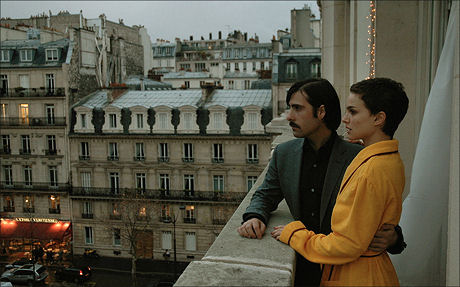

If Hotel Chevalier were nothing but just some short film, it couldn't help but feel incurably slight; if I could only use two words to describe it, they would be "wide" and "yellow". (If there was a word for Peter Sarstedt's "Where Do You Go to (My Lovely)" I'd make that three words, as that song plays nearly non-stop throughout the film.) But it's not meant to stand entirely on its own, and from its attachment to The Darjeeling Limited (it's called that film's "Part One") it musters some heft, ultimately overcoming the fact that ostensibly it feels like it was made as an acting exercise or as a sneaky excuse to get Natalie Portman naked. In the end, it really isn't slight so much as it's subtle and stinging.

In fact, Hotel Chevalier is a pitch-perfect prologue to Darjeeling. The short marks a genuine departure for director Anderson that Darjeeling only hopelessly hinted at; while the visual aesthetic is unmistakable, mostly vanished is his characteristic whimsy and his comedic self-defense mechanism; Hotel Chevalier is naked autoconfrontation, both serious and sad, just short of crossing the line into self-indulgence. The credit for its success belongs to Jason Schwartzman and Portman and their stellar performances; the script is sparing and the dialogue largely unrevealing (though it has its share of great lines: "I promise, I will never be your friend" among them), with all the backstory filled in by gestures between the leads, who obviously spent a lot of time with Anderson developing the characters' histories. The result is a film that needs nothing spoken and yet is still silently and painfully sad. When Portman arrives at Schwartzman's hotel and he jerks away from a kiss, it speaks volumes more than a subsequent exchange:

"Are you running away from me?" Portman asks of Schwartzman's holing up in the French hotel.

"I thought I already did," he answers.

---

The short can be downloaded for free on iTunes, seen in theaters before The Darjeeling Limited (and presumably on the coming DVD) or you can watch a clip here, though beware it's terribly cropped. (The original is noticeably wider at 2.35:1.)

25 October 2007

Short Film: La Jetée (1962)

Get the full credits at IMDb

Written & Directed by: Chris Marker

Watch the movie

Grade: A


La Jetée (The Pier, or Jetty), in its brief 27 minute running time, plays like a French New Wave episode of The Twilight Zone, though it's singularly unlike anything you'd ever see on television, or even in a movie theater for that matter. La Jetée, best known to today's kids as that movie that tends to pop-up in the first paragraph or two of 12 Monkeys reviews, is a film about memory, told entirely in still photographs, emphasizing the static and piecemeal character of memory, accompanied by voice-over narration—"un photo roman," (a "photo novel") Marker calls it. (Though at 27 minutes it's more like un photo romanette!)

"This is the story of a man haunted by an image from his own childhood," the narrator tells us, the image of a man dying at an airport (sur la jetée éponyme) right before our protagonist's juvenescent eyes. Set in a post-WWIII future, where the Arc de Triomphe has been de-arched, Davos Hanich is sent back in time by his fellow underground-dwelling refugees to find food and energy, or so he's told, since the outside world is a death trap of nuclear fallout and supplies are running low. Instead, he winds up running around with a woman he recognizes from that fateful airport memory. Together, they visit a number of monuments to time: a dissected tree trunk (right out of Vertigo, an objet d'obsession for Marker) and a natural history museum/taxidermist's showcase. As the narrator suggests, it's like a tour through "the museum of his memory".

Ingeniously crafted as both complex in its execution and universal in its pathos, La Jetée is a short, stinging and haunting parable about the destructive nature of the past as idée fixe; Hanich's pleas to remain in the halcyon pre-war era of his younger days ultimately leads to his undoing, captured in an iconic image of an outstretched arm against a tall and strange metal tower. Running away from the present and future, he discovers the hard way that "there was no way out of time." It's a sad lesson for the nostalgic in all of us.

09 October 2007

Short Film: No Part of the Pig is Wasted

Full credits from IMDb

Written & Directed by: Emma Perret

Grade: B


Emma Perret introduced her short film, in struggling English, as being about "the essentials: food...and men...and a pig," at the New York Film Festival on Oct. 8, 2007, and I couldn't say it better myself. No Part of the Pig is Wasted (Tout est Bon dans le Cochon) is about six isolated and poor men working construction in what looks to be the middle of nowhere. Tired of eating the same thing everyday—"fish, fish, always fish," one complains of their putrid-looking fish stew—they dream, like the POWs of Rescue Dawn, of the meals their wives or mothers used to make, which incidentally always included a bed of pork lard.

One day, one of the workers has the idea of pooling their cash together to purchase an inexpensive piglet, whom they can then raise to thick, meaty adulthood, thus turning their fantastical memories into a reality. But who knew how cute piglets are? (Certainly not I, though it should be noted that adult pigs are, well, not so cute.) The same man who suggested they buy the swine soon finds himself taking a shine to it, and must then regularly come up with excuses to stay its execution, ranging from "it's not fat enough" to "it won't taste right just yet".

The moral of this quick sweet and comic fable is obviously that carnivorism is far more difficult to practice when a face is put to the porkchops. That is, pig + personality = a creature as cute as a puppy, particularly evident in a near-final shot of the pig with his head stuck out a car window. An end of film trip to a sausage factory drives the point home, as watching blood fetishistically poured through a funnel proves remarkably unappetizing.