15 November 2007

Margot at the Wedding

Full credits at IMDb
Watch the trailer

Written & Directed by: Noah Baumbach

Grade: B

Despite its titular allusion to Baumbach's buddy Wes Anderson—really, outside of The Royal Tenenbaums, when was the last time you heard the name "Margot"?—Margot at the Wedding owes more directly to the films of Woody Allen, though to the sort of Woody Allen picture that isn't very popular; Margot... is Baumbach's Interiors, his very own wealthy/WASPy family drama set in the country. (There's also a central character reviled by her family for, in part, turning their private lives into thinly veiled fiction, à la more popular Allen vehicles like Hannah & Her Sisters and Deconstructing Harry.) The film, with its surfeit of Serious Squabbles amongst kinsfolk, comes close to self-indulgent territory, and in the spirit of the Bananas-loving public who didn't understand Woody's stab at Bergmanesque solemnity, you want to take Margot's director by the shoulders, shake him, and say, "lighten up, Baumbach!"

That's not to say that the film is entirely devoid of comedy; the young Zane Pais and the rest of the kids have their share of very funny scenes, proving, when considered with the performances of Jesse Eisenberg, Owen Kline and the other youngsters from The Squid and the Whale, that Baumbach is particularly adept at writing for and directing young people. But rather than stick to what he knows and what he's good at, he unfortunately gave into the irresistible temptation to work with Nicole Kidman, who isn't as deft in handling his particular brand of comedy and its obligatory delivery style; Kidman may be one of our most notable performers, but she, as was on display in Bewitched, is not our most capable comedienne. And why put Jack Black in a movie, as Kidman's brother-in-law-to-be, if you're just going to cast him against type as a dour depressive? Between spots of inspired amusement, including a punchline about punching people, Black's performance feels artificial otherwise, like a manic comic actor consciously and conspicuously playing himself down. (That's not to say I miss Black's usual consciously played-up mania, but pitched somewhere in the middle he's like baby bear's porridge—just right.)

Baumbach's films have always felt imitative, right from his debut Kicking and Screaming, which easily evoked Whit Stillman, right down to the casting of Chris Eigeman. But nevertheless, in fairness, he has always managed to craft his films with a unique voice; that is, Margot at the Wedding may recall Woody Allen—with nods to Mike Nichols in a silent underwater plunge and even John Boorman, presumably, with a backwoods family of frightening mountainfolk—but it's not exactly derivative, just...reminiscent.

Kidman stars as the eponymous Margot, a cold, controlling and caviling Manhattan mother, and the wedding is her sister's, taking place at their (upstate? Long Island?) childhood home where the engaged-to-Jack-Black sister, Jennifer Jason Leigh, is living.

"I thought she wasn't speaking to you," Pais asks his mother, Kidman, in reference to his Aunt Leigh.

"No, no," Kidman answers reassuringly, before adding, "I wasn't speaking to her."

Margot is superbly characterized by Kidman—what she lacks in comic skills, she makes up for in dramatics—in cooperation with Baumbach, with lines like, "watch my jacket!" selfishly spoken to her son during a bit of horseplay, or "I don't really listen to music anymore," meant, of course, to clue us in to her frigidity, both emotional and sexual. (Though Margot speaks and is spoken of as being sexually active, the only sex we see her engaged in is masturbation, and it's unsuccessfully short of climax; sex pops up in the film mostly as an external threat, showing up in peepholes, Polaroids and surreptitiously stashed pornography as well as being manifest in nymphet neighbors.)

Margot is haughtily dominating, even lecturing strangers on a forest trail about proper parenting in addition to trying to break up her sister's upcoming marriage—when Kidman complains that Black is driving too fast, Leigh notes, "Margot would insist on driving if she knew how"—but at the same time she pushes everyone away: her husband, played briefly by John Turturro in an endearing and forbearing turn, and even her son, whom she cruelly criticizes at one point for, essentially, hitting puberty. ("You used to be rounder," she tells him accusatorially, tears in his eyes.) She needs to be in charge, but she doesn't seem to want anyone around of whom to be in control.

Margot at the Wedding, like a great Woody Allen movie, is full of characters psychoanalyzing one another to avoid confronting themselves. "Pauline has transferred all her stuff on to me," Kidman charges of her sister, not realizing, or admitting, that she, and every other damn character, is doing the same thing. Unlike a great Woody Allen movie, though, there's no sympathetic anchor, or at least someone alluring, holding Margot at the Wedding down. Margot, in her middle age, has turned into a mean person, and is destroying the people, her family, around her.

Baumbach buttresses that theme with symbols, including a tree on the estate of the girls' childhood home that's rotting at the roots and killing the vegetation around it; it falls over, of course, at a climactic moment. (It's unfortunate, however, that by that point, rather than wishing the characters had gotten out of its way, I was hoping for the whole odious lot to get smushed underneath it.) In a culture and a presidential race in which "family values" are trumpeted as an essential component to a functioning democracy, Margot at the Wedding rejects that sort of sloganeering by exposing the animosity that often characterizes the bonds of family. Sure, no one loves you like your family does, but no one has the capacity to hate you quite that much, either.

14 November 2007

Black Book

Full credits from IMDb
Watch the Trailer

Directed by: Paul Verhoeven
Written by: Paul Verhoeven & Gerard Soeteman

Grade: A-

For a movie that looks so "Hollywood", Black Book (Zwartboek) is terribly grim, but that's because, despite its epic surface, it isn't Hollywood at all. Tail between his legs, unappreciated auteur Paul Verhoeven (Total Recall, Robocop) retreated to his native Netherlands, where he'd had a successful pre-Hollywood career, following 2000's uninspired Hollow Man—as a fan of Verhoeven's Hollywood work, even I wouldn't stick up for that one—to get back to his filmmaking roots; he has triumphantly reemerged with this bitter romance that, incidentally, serves as a nice allegory for his American career.

Black Book stars Carice von Houten in a masterful and old-fashioned kind of performance (she is compared twice in the film to sirens of the silver screen) as a Dutch Jew during World War II, first as an Anne Frank-type in hiding and later as a member of the Resistance, for whom she infiltrates the Nazis as a spy; it is on her own, though, that she falls in love with an SS officer (!), Sebastian Koch (fresh off of Das Leben der Anderen). Black Book could've settled to be some sort of unusual romance, but because Verhoeven and Soeteman insist on keeping matters so unrelentingly dreary it's instead less a bodice-ripper than, well, a major downer. C'est la guerre, I suppose. (Or c'est le Verhoeven.) It seems like every plan in Black Book goes awry, every escape and/or rescue ending in gun violence and bloodshed; it's just one failure after another, with von Houten just about the only one scraping through it all.

That's in large part because, as a woman, she has one advantage all other characters seem to lack (at least when dumb luck isn't enough)—her sexuality, and a conscious awareness of its power. (In contrast to Halina Reijn, her comic fille de joie foil.) In an early scene, von Houten, a Jew on the run in Nazi Germany, is riding on the back of a bicycle past some German soldiers; she picks up her dress just a few inches to their fox-whistling delight, showing that even in war sex still trumps ideology. Later, when Koch asks von Houten if she's Jewish, she pulls his hands to her bare breasts and asks, "are these Jewish?" The sex that ensues seems to imply the answer is no, though it's probably a question best referred to a theologian.

So Black Book is somber, yet sexy, both bleak and beautiful, as von Houten dyes her hair a stunning platinum blonde when she joins the resistance. She's the only one who can move with ease from the grays of the opposition's warehouse-hideouts (talk about a political movement in need of a woman's touch) to the blaring technicolors of the Nazi parties.

Most everyone in the film is made unsympathetic by Verhoeven: the resistance fighters corrupted and self-interested, more concerned with saving a handful of their own than a few dozen Jews, and the Nazis, well, are the Nazis. Even the Krauts, when freed at the war's end, turn vile and are scolded by their liberators: "you're as bad as the Nazis!" (Remarkably, or scandalously, one of the only other sympathetic characters is Koch's SS officer, even though he never even does anything particularly heroic except fall for a Jewish girl.)

The audience's enduring ability to sympathize with von Houten is, at least in part, a result of her being Verhoeven's diegetic stand-in. Before the war, von Houten was a singer, and as she says early in the film, "one day you're singing, the next you're silenced." Sounds, too, like a mournful remark from our hero director, effectively banished from the Hollywood scene. Verhoeven is best-known for making Hollywood blockbusters with a subversive twist, sometimes so subversive, as in the case of Starship Troopers, that the anti-fascist subtext went right over the heads of many viewers. In Black Book, the Third Reich functions as Hollywood and von Houten is Verhoeven, both an insider and a member of the opposition, and as such in time all sides turn against von Houten and she is left unable to sing and ultimately she finds herself relegated back to her homeland; the bookends that frame the flashback that makes up the bulk of the film finds von Houten living in Israel, just as Verhoeven wound up back in the Netherlands.

Of course if the film were merely an allegory for Verhoeven's career it would be offensively self-aggrandizing, but it can at least serve as a clue as to why the director took an interest in the girl's story and made the film in his homeland. When von Houten is humiliated by being stripped topless and having a vat of feces poured on her head, it doubles as Verhoeven's telling the audience all about how American audiences and producers shit all over him.

Just like as in Verhoeven's Hollywood career, there's no happy ending for von Houten. Verhoeven sticks up for the Jews early in the film when a man who says, "if the Jews had listened to Jesus, they wouldn't be in this mess" gets his house and family exploded but, when the film ends in Israel amidst gunfire, it feels like a political statement about the Jews' arc from aggrieved to aggressor, though it might just be the director indicating that this shit's never over. As von Houten cries in the third act, "when will it ever end?" . With all the Nazi's talk of "defeating the terrorists" throughout the film, it's hard not to start connecting the film's story to the present day, so to answer that question: never. Groan.

12 November 2007

Hotel Chevalier (Short Film)

Full Credits from IMDb

Written & Directed by: Wes Anderson

Grade: A-


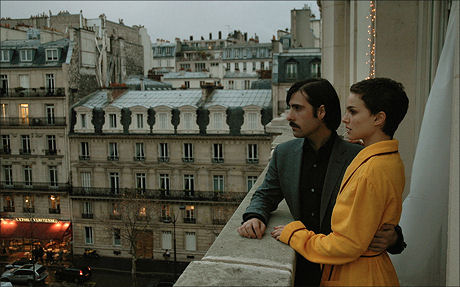
If Hotel Chevalier were nothing but just some short film, it couldn't help but feel incurably slight; if I could only use two words to describe it, they would be "wide" and "yellow". (If there was a word for Peter Sarstedt's "Where Do You Go to (My Lovely)" I'd make that three words, as that song plays nearly non-stop throughout the film.) But it's not meant to stand entirely on its own, and from its attachment to The Darjeeling Limited (it's called that film's "Part One") it musters some heft, ultimately overcoming the fact that ostensibly it feels like it was made as an acting exercise or as a sneaky excuse to get Natalie Portman naked. In the end, it really isn't slight so much as it's subtle and stinging.

In fact, Hotel Chevalier is a pitch-perfect prologue to Darjeeling. The short marks a genuine departure for director Anderson that Darjeeling only hopelessly hinted at; while the visual aesthetic is unmistakable, mostly vanished is his characteristic whimsy and his comedic self-defense mechanism; Hotel Chevalier is naked autoconfrontation, both serious and sad, just short of crossing the line into self-indulgence. The credit for its success belongs to Jason Schwartzman and Portman and their stellar performances; the script is sparing and the dialogue largely unrevealing (though it has its share of great lines: "I promise, I will never be your friend" among them), with all the backstory filled in by gestures between the leads, who obviously spent a lot of time with Anderson developing the characters' histories. The result is a film that needs nothing spoken and yet is still silently and painfully sad. When Portman arrives at Schwartzman's hotel and he jerks away from a kiss, it speaks volumes more than a subsequent exchange:

"Are you running away from me?" Portman asks of Schwartzman's holing up in the French hotel.

"I thought I already did," he answers.

---

The short can be downloaded for free on iTunes, seen in theaters before The Darjeeling Limited (and presumably on the coming DVD) or you can watch a clip here, though beware it's terribly cropped. (The original is noticeably wider at 2.35:1.)

05 November 2007

The Darjeeling Limited

Full credits at IMDb

Directed by: Wes Anderson
Written by: Wes Anderson, Roman Coppola & Jason Schwartzman

Watch the trailer

Grade: A-

The Darjeeling Limited opens with Bill Murray racing to catch the film's eponymous train but, for better or for worse, he doesn't make it. It's a clever little in-joke from Anderson, who has featured Murray in his last three films (and as such could be credited with reviving and redefining his career, Lost in Translation be damned)—Murray has missed the train and, in effect, missed the film. Outrunning him, however, is Anderson newcomer Adrian Brody, who with the legs of a healthy young man hops aboard the moving train and thus sets off the film.

Despite Murray's subsequent absence from the film, The Darjeeling Limited doesn't exactly mark new territory for Anderson; it's more like Wes on holiday, his defining motifs relocated to the Indian countryside. There's the characteristically meticulous mise-en-scene, for example, though it's tough to tell whether it's a result of Anderson's design or if that's just what India is actually like, and perhaps what attracted Anderson there in the first place. The Darjeeling Limited is a train trip travelogue, making the occasional stop for a set-piece or set-up. But it's also, like his last two films, The Royal Tenenbaums and The Life Aquatic, about family reconciliation, centered around three estranged, contentious, chain-smoking, analgesic-addict brothers, played by Brody, co-screenwriter Jason Schwartzman (Rushmore) and Owen Wilson. (In Wilson's first film appearance since his attempted suicide, he is made-up, in a striking coincidence, as bruised and bandaged.)

"I wonder if the three of us could've been friends in real life," Schwartzman says, pointing out the compulsory nature of family ties. But Wilson isn't so cynical; "I want us to be brothers like we used to," he says, and so he takes them all out on a locomotive odyssey through India, a supposed-to-be spiritual journey, with the aid of his assistant, Wallace Wolodarsky, who in supplying the laminated itineraries and essentially planning their trip makes a neat little stand-in for the fastidiously controlling director. (At one point, he even vocalizes the symbolism of a scene to the brothers, as a director would likely do, though off-camera of course.) Wolodarksy and Anderson also have a bit more than a passing physical resemblance.

When the bickering brothers are inevitably booted from the train, they lose Wolodarsky and in tandem Anderson's characteristic whimsy dissipates, the film ultimately stumbling upon tragedy in a Day-Glo toned village. After the 86ing from the train, the cute but combative rapport between the brothers gives way to the root cause of their antagonism, a difficulty in dealing with the loss of their papa a year ago and the abandonment of their mother in the time they needed her the most. Aesthetically, The Darjeeling Limited is a film of ins and outs and backs and forths, underscoring the circular path of the brothers' emotional states as they refuse to deal with the death of their father. (It's also full of Kinks tracks off of Lola vs. Powerman and Money-Go-Round, Part One and helped make that album more accessible to me than it's ever been.)

The Darjeeling Limited has an undercurrent of emotional maturity beneath its hipster eccentricity; Wilson's copious bandages are in fact a manifestation of his deep psychological scars. "I've still got some more healing to do," he says, looking at his gruesome wounds in the mirror and speaking in double entendre. The Darjeeling Limited rightly recognizes that the problems of life are too complex to wrap-up neatly in a mere ninety minutes. Walter Chaw at Film Freak Central gets it right when he says that the film is, "about growing comfortable with being lost."

"We'll never get over it," Anjelica Huston, as the long-lost mother, says to her boys. "The past happened. But now it's over, isn't it?"

"Not for us," Wilson replies, speaking for his brothers. But The Darjeeling Limited is, thankfully, a movie about learning to stop feeling sorry for yourself, not about the satisfaction of wallowing in one's own misery (proving that Anderson is a hipster only deceptively); that is, it's not, necessarily, about learning to overcome one's problems—it's not about finding "closure"—but about learning to come to terms with those misfortunes. Appropriately, running to catch their train at the end the brothers are forced to abandon their bags, tellingly their father's trunks; they are literally leaving their baggage behind, but they're still a long ways from home.

29 October 2007

Private Property

Full Credits from IMDb

Directed by: Joachim Lafosse
Written by: Joachim Lafosse & François Pirot

Watch the Trailer (no subtitles)

Grade: B-

Private Property (Nue Propriété, au francais) is conspicuously contemporary-French; anyone who's seen some recent French character pieces like The Bridesmaid or The Piano Teacher should find its aesthetic style familiar, from the digital texture and the long takes to the uncomfortable suggestions of incestuous sexuality.

Private Property moves slowly, focused on developing its characters rather than providing action because the characters are the story and their interaction is all the action you're going to get. Even the most patient and meticulous character portrait, though, must ultimately give way to some brand of narrative excitement, and Private Property is no exception; but when it does so it feels unremarkable, inspiring more of an apathetic "oh" than an involved "oh shit." It's an intimate glimpse into a complicated family unit, a tempered but contentious domestic drama set around the kitchen table and in front of the television, but when it's all over there seems something pointless about having gone through the whole thing, something a little esoteric about the drama. (Note that the most sympathetic character shares the first name of the co-author, a hint of possible self-indulgence.)

Private Property's main redeeming virtue is that it's a fine actors' piece, and most of its complexity comes from the players' glances and gestures. (Grudgingly, in fairness I suppose we could give Lafosse some credit here as well.) Isabelle Huppert, who at this point never disappoints, leads the talented ensemble, starring as a put-upon divorcee with two grown-looking sons, real life brothers Jérémie and Yannick Renier. Her strained and combative relationship with her ex-husband manifests itself in her relationship with her sons, especially Jérémie. She longs for the boys to move out of the house and out on their own so she can sell it and use the money to open up a bed and breakfast with her neighbor and lover, Kris Cuppens, but the sons, led by the headstrong Jérémie, insist she cannot sell the house, forcing her to remain in the role of mother she has occupied resentfully, so it would appear, their entire lives.

If that makes Huppert sound sympathetic in a "do your own thing, girl!" kind of way, it isn't that simple. Huppert confounds our expectations of a materfamilias by not behaving like we might imagine a mother should, namely by putting herself before her children. (Is that an American expectation?) She seems like a woman feeling held back in her life by her family, tethering her to a life, and symbolically a house, that she doesn't and probably never did want. "How long are you going to fuck up my life?" she asks Jérémie. He, like he did in L'Enfant, plays an overgrown manchild, mean and immature as in the opening scene, when Huppert is modeling a new dress in the mirror, he tells his mother, jokingly at least, that she looks like whore.

It's hard to take sides with anyone in Private Property, as all the characters come across as discomfitingly selfish. Speaking of discomfiting, there are some peculiar suggestions of improper relations between Huppert and Jérémie, particularly early on: Huppert pees with the door open as Jérémie passes back and forth, which might not be so bad except that soon after she showers in front of him, with no curtain drawn, as he brushes his teeth and leers at the mirror. The point is, I hope, to drive home the association between Jérémie and his father, played by Patrick Descamps (although that doesn't explain the Bros. Renier shampooing each other's hair in a shared bath); in many scenes, Jérémie seems like more a husband to Huppert than a son, and their fiercely antagonistic relationship, that culminates in an act of indirect matricide, mirrors the one between Huppert and Descamps. The point is that, unfortunately, the sins of the elders are inherited by the children, and one of the final images is of the two parents on their knees literally picking up the pieces...of a shattered glass table, but it's too little, too late.

25 October 2007

Short Film: La Jetée (1962)

Get the full credits at IMDb

Written & Directed by: Chris Marker

Watch the movie

Grade: A


La Jetée (The Pier, or Jetty), in its brief 27 minute running time, plays like a French New Wave episode of The Twilight Zone, though it's singularly unlike anything you'd ever see on television, or even in a movie theater for that matter. La Jetée, best known to today's kids as that movie that tends to pop-up in the first paragraph or two of 12 Monkeys reviews, is a film about memory, told entirely in still photographs, emphasizing the static and piecemeal character of memory, accompanied by voice-over narration—"un photo roman," (a "photo novel") Marker calls it. (Though at 27 minutes it's more like un photo romanette!)

"This is the story of a man haunted by an image from his own childhood," the narrator tells us, the image of a man dying at an airport (sur la jetée éponyme) right before our protagonist's juvenescent eyes. Set in a post-WWIII future, where the Arc de Triomphe has been de-arched, Davos Hanich is sent back in time by his fellow underground-dwelling refugees to find food and energy, or so he's told, since the outside world is a death trap of nuclear fallout and supplies are running low. Instead, he winds up running around with a woman he recognizes from that fateful airport memory. Together, they visit a number of monuments to time: a dissected tree trunk (right out of Vertigo, an objet d'obsession for Marker) and a natural history museum/taxidermist's showcase. As the narrator suggests, it's like a tour through "the museum of his memory".

Ingeniously crafted as both complex in its execution and universal in its pathos, La Jetée is a short, stinging and haunting parable about the destructive nature of the past as idée fixe; Hanich's pleas to remain in the halcyon pre-war era of his younger days ultimately leads to his undoing, captured in an iconic image of an outstretched arm against a tall and strange metal tower. Running away from the present and future, he discovers the hard way that "there was no way out of time." It's a sad lesson for the nostalgic in all of us.

18 October 2007

Paranoid Park

Dispatch from the New York Film Festival
View the full credits from IMDb

Written & Directed by: Gus van Sant
Watch the (Terrible) Trailer but don't judge the film by it.
Try this clip instead, though it's funnier in context.

Grade: A

Early on in Paranoid Park we see its adolescent protagonist, Gabe Nevins, from the rear as he walks towards a bench in an overgrown field to sit down and write something—a memoir? a letter?—that he calls "Paranoid Park". The first half of the film is told mostly in flashbacks, the images enunciated by Nevins as he attempts to piece together the events of his life surrounding the death of a security guard that, for all we know, he may or may not have been involved in. Mixed into these subjective sequences are objective presentations of the present, in which Nevins wanders, writing.

Mid-way through the film, we see Nevins, who by the way is, like the rest of the cast, a non-professional and perfect for the role, walking out of the aforementioned field, this time from the front. It's a reversal, Van Sant telling us he's about to backtrack, and indeed the film does go back to the beginning of Nevin's story to fill in the holes he's left as a repressed and in denial—in short, unreliable—narrator. (For example, he glosses right over if not downright ignores the pivotal night in question, when the security guard died. Van Sant amends that, and courageously sets the crucial scene to the least popular part of Beethoven's Ninth Symphony, the choral finale.)

Ostensibly, Paranoid Park is structured as a mystery, but rather than merely seek to answer an unresolved question it aims toward something higher—to reconcile the objective truth to a subjective understanding of it. Essentially, Paranoid Park is an experiment in narrative, two separate but intertwined films that represent a struggle between two opposing narrative strains: the objective image, silently narrated by an omniscient director, and the subjective image, dubiously controlled by the main character. It's also a movie about skateboarding.

But Lordz of Dogtown it's not, and anyone going in as a skateboarding aficionado is likely to be as disappointed, if not embittered, as Kurt Cobain enthusiasts were by Last Days. Since his radical reinvention of self with 2002's Gerry (mind that his preceding film was Finding "You're the man now, dawg" Forrester) as an IFC Bela Tarr (or so I hear), Gus Van Sant has been trying the patience of unsuspecting audiences with long tracking shots and coiling narratives. Or, to put it another way, a way I'm more sympathetic to, he's been wowing audiences with pensive films that refuse to supply easy answers to explain complex situations. Paranoid Park may be a bit more psychological than its predecessors, but it remains stylistically in-line. Contrary to what Jake Miller, Nevins' skater pal, says of the eponymous skate park—"nobody's ever ready for Paranoid Park"—those familiar with Van Sant's recent oeuvre should feel right at home.

Elephant, Last Days and now Paranoid Park together make a neat little triptych of character studies for Van Sant. All three share a fascination with, above all, people; while Antonioni is famous for his use of les temps morts (literally "dead time"), in which the camera lingers on a setting after the characters have left it, highlighting the opressiveness of place, Van Sant has turned it on its head and should be known for his use of les temps vivants, staying on his characters even as they uneventfully travel between scenes.

Van Sant, with cinematographer Chris Doyle, a frequent collaborator of Wong Kar-Wai's, rarely employ deep focus in Paranoid Park; the backgrounds, not coincidentally where the parents often are to be found, are blurred to emphasize Van Sant's distaste for "context". As with Elephant and Last Days, he is directly concerned only with the what and not the why. In fact, some of the most gorgeous shots in Paranoid Park are the sequences of Nevins walking through his high school's corridors, a motif familiar from Elephant where it was no less beautiful, and one sequence in particular that plays out in slow motion, accompanied by an Elliott Smith song ("The White Lady Loves You More") that has never sounded so beautiful, is downright ravishing. (It's a nice little nod to the late Smith, a Portland native, who rose to albeit brief popularity off of Van Sant's questionable exercise in mainstream cinema, Good Will Hunting.) Credit for the aesthetic satisfaction is due also to Doyle who upholds the high standard set by Harris Sevides in Van Sant's last few films.

At a Q&A after the Paranoid Park screening at the New York Film Festival, Van Sant said he was trying to make a "young adult film," (after being tactlessly accused by an audience member of making a "hipster horror film") and Paranoid Park is certainly a subtle and painful portrait of high school life and romance. By the end, the soundtrack is dominated by bouncy Nino Rota tunes that recall certain Gershwin arrangements, and Paranoid Park starts to feel, if only briefly, a lot like a pubescent Manhattan.

On a basic level, it's about the universal archetype of the confused high school student searching for an identity, and though it's never explicitly mentioned it could easily be read as a young man's confusion over his sexuality: Nevins wants to spend all of his time with his skater friend, Miller, or at the titular skate park and certainly not with his girlfriend, played in a pitch perfect performance by Taylor Momsen. He even seems a bit vexed by her desire to have sex, and their lovemaking scene is perhaps the most dispassionate I've ever seen. To boot, there is even a suggestive cafeteria scene in which a corn dog might not be just a corn dog.

For all the stress in Nevins' life, whether over his parents' looming divorce, the death of the guard, his needy girlfriend or his uncertain sexuality, there's always a measure of relief in the act of skateboarding. Watching the hooligans ollying at Paranoid Park, a cavernous series of round peaks and valleys, Nevins proves himself wise enough to realize that, "no matter how bad your family life was, these guys had it much worse." But in the skateboarding interludes, filmed in 8 and 35 mms with a slo-mo reverence, Van Sant uses the skateboarders' seeming renunciation of the laws of gravity as a symbol of their freedom, albeit only a temporary liberation, momentarily lost in the air and free from terrestrial constraints and concerns. Skateboarding becomes a manifestation of deliverance, except perhaps in the hidden-camera fisheye lens shots that show cops, with black bars for eyes, writing tickets to the real life Portland skaters. All ollies must come down, just as all repressed memories have to be confronted sooner or later.

--

Click Here to read the minutes of a Q&A van Sant had at the New York Film Festival about Paranoid Park at our sister blog, The Blog Apple.

Death Proof

Full credits from IMDb

Written & Directed by: Quentin Tarantino

Grade: B+ (First hour: A/Second hour: B-)
Watch the Trailer

Death Proof opens on a pair of shapely feet, with polished toes, natch, resting on a sunlit dashboard. Tarantino needn't even bother putting his name in the credits anymore.

On DVD, Death Proof has been divorced from its husband, Robert Rodriguez's Planet Terror, after only a few months of marriage, and "Grindhouse" is no longer a movie, just, at best, a guiding philosophy. So now we have a "Director's Cut" of Death Proof, but it turns out to be too much of a good thing; the "reel missing" titles from the Grindhouse presentation have been replaced by the actual reels, but as it then stands Death Proof feels like it could stand to lose a reel, or all of its second half for that matter.

The first half of Death Proof is damn near perfect, but I suppose it's so good that the film has nowhere to go but down. The first section of the film, sweaty and smutty, is shot in a grainy '70s style, meant to evoke the grindhouse features to which Tarantino is, in a way, paying homage. For good measure, he tosses in some built-in scratches to the film (somewhat analogous to buying jeans with holes already torn in them) and some skittery moments, so that in the end it feels like watching a beat-up print being played through a shitty projector by an asshole projectionist.

Surprisingly, the gimmicks pay off, as they're meticulously incorporated and totally convincing, so that when one character pulls out a cellphone it feels anachronistic. (It's used, though, for the most touching text message that's yet been filmed.) Once again, as in the Kill Bill dyad, Tarantino has managed to create a work of pure pastiche that is still uniquely and unmistakably Tarantino's own. It is tribute as only he could pay it.

A gaggle of short-shorted girlies occupy the film's first half; they're on their way out of Austin to an uncle's lakehouse but first they're going to stop at every decent roadhouse and margaritaville along the way. (I could've stayed in the last bar they visit all movie long, what with all the T-Rex, Joe Tex and Stax spinning on the jukebox, but unfortunately the bar, and the women, are excised from the film Marion Crane style, though at least we get a gruesomely delicious killing sequence.) There's plenty of unmistakably Tarantino dialogue, stylized chick confab with lines like, said in the pouring rain, "it's wet as 'Nam out there!", not to mention that these are all strong and independent women along Beatrix Kiddo lines, while all the guys they meet are whiny, conniving and scummy. (That last point is driven home once you realize that that's scumbag extraordinaire Eli Roth playing one.) It's an important point, since it makes up for, or at least evens out, the surfeit of sexploitation, complete with copious ass shots and a spicy lap dance sequence. They're not strong or independent enough, though, to be able to take on Kurt Russel, who's been tailing them in his pirate-flag-black automobile, complete with a Jolly Roger painted on the hood.

Once the satisfaction of the first half is done and gone, though, Tarantino sort of repeats it, introducing a different but similar group of girls. But the grindhouse gimmicks and '70s markers are mostly gone, and the new cast of women significantly less likable than the ones that went before. The second half of Death Proof feels like a poor decades-later sequel to a cult classic, and the once crackling dialogue now feels forced, particularly coming out of the mouth of Rosario Dawson, who proves herself as able to deliver Tarantino-dialogue as Scarlett Johanssen was able to do prove her talents as comedienne by doing a Woody Allen impression in Scoop. (That is to say, not at all.)

That's not to say, though, that the second half is without its merits; it features a rousing car chase/duel sequence that goes on for more than a reel, for example, and (spoiler) is at least mildly interesting in its reversals of horror movie convention: rather than have a last girl standing, many girls remain standing, and they turn around to attack their aggressor, who flees in panicked terror. I suppose that measure of girl power is equal parts Tarantino and grindhouse tribute, in the tradition of chick revenge flicks, although if Death Proof were really a grindhouse movie I'm sure we would've found out what happened to the girls' friend who, dressed as a cheerleader, they abandoned with a mountain man/grease monkey.

09 October 2007

Short Film: No Part of the Pig is Wasted

Full credits from IMDb

Written & Directed by: Emma Perret

Grade: B


Emma Perret introduced her short film, in struggling English, as being about "the essentials: food...and men...and a pig," at the New York Film Festival on Oct. 8, 2007, and I couldn't say it better myself. No Part of the Pig is Wasted (Tout est Bon dans le Cochon) is about six isolated and poor men working construction in what looks to be the middle of nowhere. Tired of eating the same thing everyday—"fish, fish, always fish," one complains of their putrid-looking fish stew—they dream, like the POWs of Rescue Dawn, of the meals their wives or mothers used to make, which incidentally always included a bed of pork lard.

One day, one of the workers has the idea of pooling their cash together to purchase an inexpensive piglet, whom they can then raise to thick, meaty adulthood, thus turning their fantastical memories into a reality. But who knew how cute piglets are? (Certainly not I, though it should be noted that adult pigs are, well, not so cute.) The same man who suggested they buy the swine soon finds himself taking a shine to it, and must then regularly come up with excuses to stay its execution, ranging from "it's not fat enough" to "it won't taste right just yet".

The moral of this quick sweet and comic fable is obviously that carnivorism is far more difficult to practice when a face is put to the porkchops. That is, pig + personality = a creature as cute as a puppy, particularly evident in a near-final shot of the pig with his head stuck out a car window. An end of film trip to a sausage factory drives the point home, as watching blood fetishistically poured through a funnel proves remarkably unappetizing.

08 October 2007

The Assassination of Jesse James by the Coward Robert Ford

Watch the Trailer (Trailer of the Year!)

Written & Directed by: Andrew Dominik
Full credits from IMDb

Grade: A

At Blockbuster, Westerns are considered a subgenre of "Action", meaning that all the Western pictures a given Blockbuster store has for rent are likely to be found in the Action section. (Very few stores have the demand for a distinct Westerns section.) This occasionally leads to some peculiar categorizations; for example, Jim Jarmusch's Dead Man, just about the antithesis of an action film, is to be found sitting on the shelves between Demolition Man and Die Hard. (The alphabetization is "loose".)

Along those lines, The Assassination etc. etc. is sure to be miscategorized once it hits DVD; it's a no bones Western, but it certainly doesn't belong in the action section of the video store. Sure, it has an exciting train robbery sequence stuck into its opening reels, but the remainder of the film is short on shoot-em-up set-pieces, opting instead to be a meticulous study of the two eponymous characters' simmering hostilities towards one another to the point of their boiling over. It's a dialogue-driven character study, but though a talky film, the meat isn't in the dialogue; this is, above all, a purely visual film, patient, poetic and painterly, that wouldn't lose much of its meaning if you shut off the dialogue track. (Though Nick Cave and Warren Ellis' score is perfect, so you should leave it in.)

The movie tells its story primarily through Roger Deakins' sumptuous photography, often blurred at the edges to emphasize the haziness of history, and the gazes of its two leads, Brad Pitt and Casey Affleck. The Assassination of Jesse James... essentially boils down to two sets of eyes. Pitt says volumes more, for example, when introduced as James, staring teary-eyed at fires mysteriously raging on a desert plain, than he does in any moment of dialogue, like the subsequent scene in which he mocks the late President Lincoln's sexual vitality. As Paul Schneider, as a member of the James Gang, notes early on, emphasizing the film's guiding philosophy, "you can hide things in vocabulary." The flip side to that, of course, is that images, in their honesty, belie the false claims of deceitful language. This is a director, and a director of photography, who have a deep understanding of the visual component of their medium and its contrapuntal relationship to text.

Overall, The Assassination of Jesse James by the Coward Robert Ford, like its full title, is a bit drawn-out and is bound to test the patience of most who go into it; the most obvious parallel would be to the films of Terrence Malick, though it's not as lethargic or conspicuously pretentious as Malick's work tends to be. (N.B. I generally like Malick, so I mean those criticisms cheekily.) The two-plus hours of viewing effort pays off, however, in a masterful coda that brings it all together, proving the film to be an allegory for how easily the cocky, ruthless ambition of youth turns into desiccation and the deep regret of old, or middle, age. While watching it, the film might feel too long, but by the end those feelings ought to have evaporated. It feels just right, and for those who can't make it to the pay-off, Dominik has a built-in criticism early on, again from the mouth of Schneider: "poetry don't work on whores."

Crude, I agree, but the film is chockablock with that sort of vulgar talk that outlaws surely awash themselves in. The film finds Jesse James long past his heyday, at the age of 34, living in obscurity under a pseudonym and gradually descending into paranoia, suspicion and derangement. "Sometimes I hardly recognize myself," James says in a moment of lucidity. "I wonder about that man," he says of himself, "that's gone so wrong." Along comes a bright-eyed, sycophantic whippersnapper by the name of Bob Ford (Affleck) who claims an "appetite for greater things," seeing himself destined for eminence while obsessed, in an unhealthy, 13-year old girl manner—complete with embarrassed temper-tantrums and a shoebox of mementos under his bed—with the infamous bandit Jesse James. The front of his Trapper Keeper would be hardly visible for all the drawn hearts with Jesse's name scrawled in them, Cupid's arrow poking through their cores.

Though Jesse's brother, played by Sam Shepard, dismisses Ford as nothing but a child chasing nickel-book stories, James, taking a flattered and bemused shine to the boy, takes him under his wing, and alternately pushes him away and draws him closer until each feels compelled to kill the other. For the sake of concise explanation, IMDb's plot summary explains it this way: "Robert Ford joins Jesse James's gang, only to become resentful of the legendary outlaw," but to ascribe Ford's motivations to sheer resentment is damagingly reductive; what makes The Assassination of Jesse James and so on so compelling is the essential mystery underlying the relationship between the two men, especially the mystery beneath Affleck's somnolent and sexual stare, all at once of the sort wives show their husbands, mothers their sons, sons their fathers and the drowsy their beds.

(Pitt is fantastic as James, in full-on weepy Babel mode, though with his eyebrows generally leveled, but it's Affleck, with a wonderfully added pubescent crack in his voice, whose performance proves revelatory.)

James himself hits the nail on the head when he asks Ford: "do you want to be like me or do you want to be me?" It's Ford's emulation of James that leads him to kill his idol, enemy and best friend; the pusillanimous gunshot is analogous to all of the merciless slayings, few of which are seen in the film, that weigh heavy on James' eyes. (The film's key scene may be that in which James ferociously beats a young boy in the hopes of getting information on the whereabouts of the boy's uncle, only to fall into a paroxysm of weeping, hiding his face against his horse, moments later.)

After the sad assassination, Ford and his brother Charlie, a stirring turn from the under- or generally mis-used Sam Rockwell, take to the New York stage, recreating the killing in public over 800 times as though trapped in a very special type of hell. The repetition of the act, and its historical revisionism, exposes the artifice and mendacity of legend and the disconnect between a man and his mythos, and robs the murder of a ruthless robber of its potential heroism and rectitude. James achieves legendary status and Ford, in history's eyes, becomes Brutus' companion in the ninth circle of Hell. Ford assumes the burdensome guilt and loneliness of his victim and learns the vicissitudes of celebrity and "greatness". It's a beautiful section and it stings deeply as films rarely do. Suddenly, marvelously, the whole film clicks into place. Dominik's film may be lengthy, but it's never digressive nor superfluous; he knows exactly where he's been going the entire time.

"You know what I expected?" a now wise-beyond-his-years Affleck asks his Mrs. Miller incredulously in his later years. "Applause." You got it, buddy; can't you hear me in the back of the theater?

04 October 2007

Eastern Promises

Directed by: David Cronenberg
Written by: Steven Knight

Grade: B-

Eastern Promises opens in the rain—oh, David Cronenberg's in London again. This time, though, instead of dealing with the mentally ill and the ghosts that haunt them, as he did in Spider, he takes on the Russians, both assimilated, in the form of midwife Naomi Watts (whose character just broke up with her, gulp, black boyfriend), and unassimilated, in the form of the Russian Mafia (none of whom is black).

There seems to be a general trend with this movie's reception: those who did not much care for Cronenberg's previous, ahem, masterwork A History of Violence are singing its praises, while fans of that film are, by and large, disappointed by Eastern Promises; forgive the conformity and predictability, but I fall into that latter camp. In one crucial way, Eastern Promises is the opposite of its predecessor: though both star Viggo Mortensen, A History of Violence was about a inarguably great guy who turned out to have an evil (that is, violent) side, while Eastern Promises is about a manifest bad guy who in fact turns out to be good. Doesn't Cronenberg know that a transformation into wickedness is far more fascinating, and universally compelling, than a turn to virtue? That's how they sell newspapers, anyway.

But it's not really Cronenberg who's primarily to blame for Eastern Promises' disappointment; if anything, it's only by his graces that the film has any merit. The problem lies with the screenplay by Steven Knight—who's credited, among some film scripts, with creating the television series Who Wants to Be a Millionaire? (albeit the original British version)—which tells a pretty straightforward Hollywood story while lacking a clear hero; Mortensen's character is so steely, demonstrating his callous nature by showing off his callous tongue, which he uses to extinguish a cigarette, that he pushes the viewer away, and while Watts would ordinarily be a proper audience surrogate she is reduced to a practically marginal character. That is to say, the story is a bit unfocused, offering the viewer no way in and nothing to hold on to. You could sympathize with Viggo's wondrous everyman in History and then take his unraveling roller coaster ride with him, but Eastern Promises leaves you out in the rain from frame one.

In a way, Eastern Promises picks up where History of Violence left off; in the latter, a single act of violence set off an uncontrollable chain, the point being that violence begets violence, in a domino effect of increasing severity. In Eastern Promises, the chain has already been set off long ago, and the world Cronenberg sets up is one already mired in violence, as we learn from the opening scene that features a graphic, as is Cronenberg's custom, throat slicing at a barbershop. (Worst shave ever!)

In the following scene, a pregnant woman collapses in a(n?) Аптека and later dies; Watts is able to save her baby, though, who, born around Christmas, is named Christina. (Like Children of Men, this is a very Catholic film about hope for the future built on the ashes of a corrupted past.) The dead girl left behind a diary, unfortunately written in Cyrillic, that Watts' thick-accented uncle, the Polish director Jerzy Skolimowski, warns her to stay away from. "Bury the secrets with the body," he advises but she, unwilling to heed such good advice, goes poking her nose into places it doesn't belong (smelling, as this is a film about Russians, borscht, among other things) and she, like her character in Mulholland Dr., is thrust into an indismissable mystery.

Despite strong supporting performances from Armin Mueller-Stahl and, especially, Vincent Cassell as Mortensen's underworld cohorts, the mystery is unremarkable, the characters virtually arc-less, and Eastern Promises peters out to an unnecessary twist that manages to refute any measure of complexity which the film had, to then, been building. (SPOILER: It's a poorly paced and misstructured Donnie Brasco! A sudden reversal of character doesn't pass for character development END SPOILER.) At least, with Cronenberg at the helm, we get a naked fight scene in the Finsbury Baths that does for violent action what Borat's infamous and analogous fight scene did for hilarity.

The Host (Gwoemul)

Directed by: Bong Joon-Ho
Written by: Baek Chul-Hyun, Bong Joon-Ho & Ha Jun-Won

Grade: A-

With The Host, Bong Joon-Ho has incontrovertibly affirmed his unrivaled talent as a contemporary reinventor of the classic American genre film. He's an innovative traditionalist, as evidenced first in 2001 by Memories of Murder, the best cop movie of at least the last decade, and now he has reworked the monster movie the same way with The Host, the best monster movie at least since Hollywood effectively stopped making them (we'll ignore the Godzilla remake, for example) all those decades ago.

On its face, The Host is your basic environmental allegory: the abuse of nature, in this case pollution (by callous American scientists who dump a crate's worth of "dirty" formaldehyde down the drain and into Korea's Han River), leads to the creation of a "monster" who reeks its vengeance on humanity. (The film is heavily critical of America; Americans not only are responsible for the mutant legged killing fish that murders several Koreans, but the military's dishonesty about it leads to deaths of many more Koreans by poisoning!)

Bong, as in Memories of Murder, plays the first half of the film as comedy, teasing out the implicit absurdity of the genre. Unlike many comedies of exaggeration, the fine cast, led by the marvelous Song Kang-Ho, don't act as though aware of how hilarious they are, and thus allow for some genuinely funny moments.

But Bong carefully balances the comedy with action/horror, especially in the virtuosic sequence in which the monster first appears (worthy of Spielberg at his very best), and eventually the humor dissolves into pathos as characters die, Song's daughter, Ko Ah-Sung, is abducted and her father and his siblings must face their essential impotence to act against massive, international government bureaucracy (expressed not only in the military occupation but in the labyrinthine sewer system.) The movie drags a bit in the second act, as the family gathers supplies and fruitlessly searches the sewers for the creature, but when Bong is on, as he is for example when the monster appears, he's on, and for the bulk of the rest of the film he demonstrates his flair for weaving action, drama and comedy together, as they are often woven in real life: without any of the them ever ringing false. He even allows for a bittersweet ending that the likes of Spielberg would never have permitted, despite its (albeit circuitous) affirmation of the family unit.

Like many, if not most, movies coming out of Asia today, The Host seems packed with subtext directed at its native audiences that mostly goes over my head, such as a repeated criticism of the Korean economy: it's mentioned more than once that Song's brother, Park Hae-Il, is a college graduate but can't a job, while everyone seen employed in the film has a low-paying, dead-end position, like Song and his father who own and operate a modest food stand.

But the anti-American subtext is easy to catch for any audience; as the Japanese monster movies of the mid-Twentieth Century were often about the atomic bomb and its effects, The Host could easily be read as, what else, an allegory for The War on Terror. When the American military uses violence, against a monster of its own creation, mind you, it's mostly a lot of innocent civilians who are hurt in the process.