26 November 2007

Hot Fuzz

Full credits from IMDb
Watch the trailer

Directed by: Edgar Wright
Written by: Edgar Wright & Simon Pegg

Grade: B

Though British, Hot Fuzz is part cheeky send-up of and part loving homage to the American action film. (And that's not Sam Peckinpah or Don Siegel, mind you, but less "respectable" fare such as Bad Boys II and Point Break.) The impeccable straightman Simon Pegg stars as a London supercop who, because his diligent policing makes his fellow bobbies look bad, is reassigned to the English countryside beat, which the filmmakers use as an opportunity to play every Kinks song with "Village Green" in the title. (All two of them!)

Hilarity ensues, as do a series of gruesome murders, a halfhearted commentary on the dark underbelly of England's superficially serene rural areas. But Hot Fuzz isn't really concerned with politics so much as it is with hilarity, and as with the filmmakers' previous outing, Shaun of the Dead, the film's ample amount of laughs stem, in equal measure, from the genre spoofing as well as from the natural comic acumen (and comic-foil rapport) of the leads, Pegg and Nick Frost. They're the best duo working in comedic films today, in that old-fashioned funnymen sort of way, carrying on in the rich tradition of Abbott & Costello or Randall & Klugman. (Hot Fuzz also acknowledges its place in the continuum of English humor by casting as Pegg's superiors, in order of rank from lowest to highest, Martin Freeman, Steve Coogan and Bill Nighy.)

Hot Fuzz's problem, though, is that it gets a bit carried away with its genre-indulgence, pushing the two hour mark to to cram as many extended shoot-ups and car chases as possible into its second half. Still, the leads' gifts for comic delivery and the filmmakers' deeply felt appreciation of the genre keep it compelling enough, if a bit trivial, through to the end.

25 November 2007

Vacancy

Full Credits from IMDb
Watch the Trailer

Directed by: Nimród Antal
Written by: Mark L. Smith

Grade: B+

At root, Vacancy is a horror movie about two characters who gradually become aware that they're two characters within a horror movie, but Antal keeps the tone straight-faced, blessedly avoiding any Scream-style, self-aware cheekiness. Packed full of conventional set-ups, the film stars Luke Wilson and Kate Beckinsale as a married couple on the verge of divorce, on their way home from Beckinsale's mother's home on a side road, having made the fundamental mistake of getting off the interstate. (Never get off the main road!) A lot of "we're not lost!" bickering ensues, then the car breaks down, the mechanic can't fix it till morning and there's a nearby motel with no other guests, only a creepy night clerk (a mustachioed Frank Whaley).

Beckinsale refers to their stay in the filthy room they rent as their "one last great adventure together," but she is unaware of the real adventure about to unfold! In a well-crafted sequence of Wyler/Toland-esque close-ups—the film is full of artsy angles and is gorgeously lit, courtesy cinematographer Andrzej Sekula, of Pulp Fiction fame—Wilson starts popping-in video tapes lying on top of their room's television set, finding a series of gruesome snuff films that he slowly begins to realize have been filmed in the very room he and his wife occupy. With hardly a moment to think, the events that start off the tapes begin to happen to them: there's deafening banging on the wall; the power flicks on and off; the door, chained shut, rattles on its hinges.

The couple manages to stave off their murder long enough for the film to become a home-invasion thriller, albeit one set in a very cramped home. (It may be the honeymoon suite, but it's still a motel room.) The recent French film Ils (Them), a similarly metacinematic home-invasion horror flick, may be a little more clever and executed a bit more tautly, but, especially for a Hollywood flick, Vacancy is surprisingly smart and tight, clocking in at only a few minutes over eighty.

Wilson, whose usual easygoing and deadpan comic style allows him to easily disappear into an everyman horror-protagonist, finds the time to go through some of the tapes, looking for mistakes past victims have made and essentially parsing the horror conventions, searching for a way to survive. "It's not enough that they rob and kill these people," he says pitiably, "they want to watch it, too." Yeah, America, what's the matter with you? When a truck driver turns up, Wilson and Beckinsale bang on the window of their locked-room as though it's the movie screen, begging for help until, when the driver slowly approaches their room and the couple sees the killers following from behind, they reverse roles to become the typical spectator, shouting the standard horror movie response: "look out, behind you!"

The filmmakers aren't quite able to keep up with the film's postmodernist angle, and what began as a sort of commentary on horror movie violence slips into an exercise in mere horror movie violence, but Vacancy, still, is the product of strong filmmaking, and it's short and well-paced enough to go by quickly and stirringly, without ever getting too full of itself.

23 November 2007

Southland Tales

Full credits at IMDb
Watch the Trailer

Written & Directed by: Richard Kelly

Grade: A-

Southland Tales, an apocalyptic fever-dream of a film, is both, or perhaps neither, a failure and a startling success. As a political fable and a largely impenetrable allegory, let's say it's a spectacular failure. All at once, it's an exhilarating and confounding examination of cinematic spectatorship, metaphysics, Christian mythology, soldier's remorse and the current state of Americo-geopolitics. It also dabbles—why not, at this point?—in time travel theology and a rift in the fabric of the fourth dimension, but that sort of philosopho-scientifica is only to be expected from Richard Kelly, the film's young director who, six years ago, made the impressive and unexpected Donnie Darko.

Like that film, Southland Tales seems hell-bent on contemplating a series of compelling cosmic conundrums that no one but Kelly has ever bothered to brood over. (For example, if a time traveler came into contact with his double, would it affect the speed of the earth's rotation?) For the first several reels, I really wasn't sure what to make of Southland Tales; the early parts of the film are mired down with extended exposition, setting up Kelly's batshit yet surprisingly, and frighteningly, reasonable vision of an American future in which all hell has broken loose following a nuclear attack on the Texas town of Abeline. "This is the way the world ends," Justin Timberlake, our narrator perched atop an ocean turret, informs us, alluding to T.S. Eliot. (Set on the eve of the '08 presidential election, the Republican candidates for president and vice president are, respectively, men named Eliot and "Bobby" Frost. Make of it what you will.)

Ostensibly, Southland Tales is a somewhat long-winded account of terrorism's indirect effect on civil liberties, the hitherto rowdiest and most lyrical expression of post-9/11 and Iraq War anxiety, but though politics are a substantial part of the film, they're really only the jumping off point. That's the thing about Southland Tales: it's madly ambitious to the point of becoming intimidatingly sprawling. (Trying to actually summarize the plot would be pointlessly reductive, as it's far too complex to boil down in a reasonable amount of space, thus the film's central problem.) Like Mulholland Dr., which it evokes and borrows from—including the songstress Rebekah Del Rio, who pops up to sing what sounds like the National Anthem—it seems like it might be better suited to a television series or some other more leisurely narrative medium. (A three-part prequel, written by Kelly, has been published as a graphic novel.) That it's tonally inconsistent, bouncing carelessly between puzzlingly broad comedy and straight-faced earnestness, is no help in trying to parse its message and meaning.

It's easy, as many critics (and audience members, surely) have done, to write-off Southland Tales as a convoluted catastrophe, but it's so dense with message and meaning that it's not something to be so easily written off. The film may not exactly work, but at least it's not as a result of laziness or lack of substance like so much substandard fare. After Kelly gets his exposition out of the way (one wonders if a pre-film backstory handout, as I understand was given out to accompany David Lynch's Dune, might have been appropriate), he starts flexing his technical muscles and the film gets tighter and tighter in their grip until the credits roll and the audience, or the parts of it that haven't walked out anyway, is left breathless. Nearly the entirety of the film's long climactic sequence, set upon a "megazeppelin", is a masterpiece of form, and both a musical sequence/beer commercial set to a Killers tune, featuring a lip-synching Timberlake on a break from his narrator role, and a scene in which Seann William Scott teases his "delayed reflection" in a mirror are unforgettable. (As is, to cite one more, the image of two cars boinking one another, a nod to the fornicating airplanes in Dr. Strangelove's opening credits.)

Through Mr. Scott's character, one thing Kelly's film does, and does extremely well, is expressionistically investigate the nature of remorse, and as such, for me, it recalled last year's much-derided (wrongly so!), poetically epic The Fountain. Mr. Scott, most familiar from his turns as Stifler in the American Pie series, gives the film's most revelatory performance, although Sarah Michelle Gellar, a co-star, proves herself a surprisingly deft comedienne. (I assumed she was only capable of producing lame horror movies.) Scott shows a dramatic range I would never have expected; unfortunately, it doesn't look like a turning point for his career as, according to IMDb, his upcoming projects include titles like Ball's Out and Coxblocker.

The entire film is populated by cultural icons, including the Rock, er, Dwayne Johnson, Mandy Moore and a handful of SNL castmembers past and present, all of whom find themselves hooked up with the underground movement resisting the sinisterly corrupt bureaucracy oppressing the film's near-future United States. Despite the film's showbiz satire and Hollywood send-up, the suggestion is that the American opposition, for better or for worse anyway, begins in Hollywood, and hence the film. Indeed, one of the government's monitors in the film, and one of the audience's surrogates, played by Michele Durrett gluttonously stuffing cheese puffs into her mouth (does anything more aptly spell "American"?), becomes politically active only after she reads the prophetic screenplay-within-the-film that parallels the story we're seeing. That is, Southland Tales says that it takes Southland Tales to help save the day, and of course ordinary people are only going to see it if there are famous people in it.

19 November 2007

No Country for Old Men

Full credits from IMDb
Watch the Trailer

Written & Directed by: Joel & Ethan Coen

Grade: A

The Bros. Coen's No Country For Old Men opens with a series of shots of the West Texas landscape. Cinematographer Roger Deakins fills the screen, primarily, with the land, leaving very little visible sky, signaling to the audience that the story you're about to see is not one of heavenly redemption but one of earthly sin, a story set in a violence-ridden world devoid of any divine interaction, let alone intervention. From frame one, the directors make it clear that whatever's about to happen, it's not going to end well.

The bloodletting begins moments into the very first reel, in which we see the film's supervillain, Javier Bardem, kill the film's first victim, a sheriff's deputy—the first thing to go in this depraved world is, of course, the order of law—in a strangling struggle with, brushed across his face, the terrifying look of a clown having a perverse orgasm. Bardem, a merciless killer or, as the film calls him, "the ultimate bad-ass", plays every one of his scenes with a sense of unflappable menace, countered by a watery-eyed gaze of profound feeling that elevates his assassin extraordinaire beyond a stiff Frankenstein of a sociopath.

In the scene following the handcuffed garroting, Bardem kills a motorist with his preferred method of murder: a jolt from an air gun, ordinarily used to slaughter cattle, to the forehead. (Conveniently, he also uses it to open locks.) Bardem the manhunter is then paralleled to Josh Brolin the antelope hunter; introduced setting up a shot on the desert plains, the Coens foreshadow the bloodshed and role reversal (hunter to hunted) about to befall him. The catalyst in this disastrous transformation is the suitcase full of hundred dollar bills in $10,000 stacks that Brolin stumbles across, while hunting, in a gory milieu of dead men and dead dogs (and a trunk full of brown heroin that Brolin wisely lets be.) But by taking the cash, he gets bounty-hunter Bardem on his trail and spends the rest of the film running across Texas trying to lose him, with hangdog sheriff Tommy Lee Jones, with a wit as dry as the surrounding desert brush, one step behind them at all times, bearing witness to the destruction they've produced.

No Country for Old Men works as a perfectly-executed piece of genre fiction, suspenseful and frightening, just like its source novel by Cormac McCarthy, which it smartly follows almost to the letter, excising only some extraneous characters to maintain the script's disciplined focus. The film's greatest asset, though, is that the Coens have thankfully dropped their propensity for eccentricity, which has always been their Achilles' Heel as filmmakers. No Country for Old Men has no goofy central or ancillary characters; front and center, there are only serious actors at the top of their games while the film's margins are filled-in by authentic Texans. (Beth Grant's turn as Brolin's mother-in-law is the only exception, but her appearance is so brief that it's easily forgiveable.) The Coens mercifully, by and large, don't portray the film's Texans as quirky and exotic goofballs as they did to the Midwesterners in Fargo or the Southerners in O Brother, Where Art Thou?

No Country for Old Men is an action film both measured and grave, opening as a Jim Thompson-esque crime saga set on the Texan sands, but as it moves along the film acquires an allegorical depth, raising questions about the state of American culture and morality as it follows a steady stream of blood that's all been spilled over a few million dollars. "It's all goddam money," an El Paso sheriff notes. The Coens take McCarthy's grumpy red-state gripes, like the one about kids with green hair, with a grain of salt, but nevertheless stay to true to his overarching theme: the violence that Jones is seeing, that causes him to declare, "I feel overwhelmed", isn't novel—it may be a bit gruesome, as Bardem kills people as though they're cows, for Pete's sake, but certainly not moreso than the violence of Blood Meridian—just another iteration of the frontier violence that harkens back to the old days of Indian battles. (And, if you follow the logic, all the way back to the American revolution.) "What you got ain't nothing new," Jones' uncle, Barry Corbin, tells him. "This country's hard on people." America is a country founded on violence that has never stopped fighting, whether against the elements or, as is more common, one another.

15 November 2007

Margot at the Wedding

Full credits at IMDb
Watch the trailer

Written & Directed by: Noah Baumbach

Grade: B

Despite its titular allusion to Baumbach's buddy Wes Anderson—really, outside of The Royal Tenenbaums, when was the last time you heard the name "Margot"?—Margot at the Wedding owes more directly to the films of Woody Allen, though to the sort of Woody Allen picture that isn't very popular; Margot... is Baumbach's Interiors, his very own wealthy/WASPy family drama set in the country. (There's also a central character reviled by her family for, in part, turning their private lives into thinly veiled fiction, à la more popular Allen vehicles like Hannah & Her Sisters and Deconstructing Harry.) The film, with its surfeit of Serious Squabbles amongst kinsfolk, comes close to self-indulgent territory, and in the spirit of the Bananas-loving public who didn't understand Woody's stab at Bergmanesque solemnity, you want to take Margot's director by the shoulders, shake him, and say, "lighten up, Baumbach!"

That's not to say that the film is entirely devoid of comedy; the young Zane Pais and the rest of the kids have their share of very funny scenes, proving, when considered with the performances of Jesse Eisenberg, Owen Kline and the other youngsters from The Squid and the Whale, that Baumbach is particularly adept at writing for and directing young people. But rather than stick to what he knows and what he's good at, he unfortunately gave into the irresistible temptation to work with Nicole Kidman, who isn't as deft in handling his particular brand of comedy and its obligatory delivery style; Kidman may be one of our most notable performers, but she, as was on display in Bewitched, is not our most capable comedienne. And why put Jack Black in a movie, as Kidman's brother-in-law-to-be, if you're just going to cast him against type as a dour depressive? Between spots of inspired amusement, including a punchline about punching people, Black's performance feels artificial otherwise, like a manic comic actor consciously and conspicuously playing himself down. (That's not to say I miss Black's usual consciously played-up mania, but pitched somewhere in the middle he's like baby bear's porridge—just right.)

Baumbach's films have always felt imitative, right from his debut Kicking and Screaming, which easily evoked Whit Stillman, right down to the casting of Chris Eigeman. But nevertheless, in fairness, he has always managed to craft his films with a unique voice; that is, Margot at the Wedding may recall Woody Allen—with nods to Mike Nichols in a silent underwater plunge and even John Boorman, presumably, with a backwoods family of frightening mountainfolk—but it's not exactly derivative, just...reminiscent.

Kidman stars as the eponymous Margot, a cold, controlling and caviling Manhattan mother, and the wedding is her sister's, taking place at their (upstate? Long Island?) childhood home where the engaged-to-Jack-Black sister, Jennifer Jason Leigh, is living.

"I thought she wasn't speaking to you," Pais asks his mother, Kidman, in reference to his Aunt Leigh.

"No, no," Kidman answers reassuringly, before adding, "I wasn't speaking to her."

Margot is superbly characterized by Kidman—what she lacks in comic skills, she makes up for in dramatics—in cooperation with Baumbach, with lines like, "watch my jacket!" selfishly spoken to her son during a bit of horseplay, or "I don't really listen to music anymore," meant, of course, to clue us in to her frigidity, both emotional and sexual. (Though Margot speaks and is spoken of as being sexually active, the only sex we see her engaged in is masturbation, and it's unsuccessfully short of climax; sex pops up in the film mostly as an external threat, showing up in peepholes, Polaroids and surreptitiously stashed pornography as well as being manifest in nymphet neighbors.)

Margot is haughtily dominating, even lecturing strangers on a forest trail about proper parenting in addition to trying to break up her sister's upcoming marriage—when Kidman complains that Black is driving too fast, Leigh notes, "Margot would insist on driving if she knew how"—but at the same time she pushes everyone away: her husband, played briefly by John Turturro in an endearing and forbearing turn, and even her son, whom she cruelly criticizes at one point for, essentially, hitting puberty. ("You used to be rounder," she tells him accusatorially, tears in his eyes.) She needs to be in charge, but she doesn't seem to want anyone around of whom to be in control.

Margot at the Wedding, like a great Woody Allen movie, is full of characters psychoanalyzing one another to avoid confronting themselves. "Pauline has transferred all her stuff on to me," Kidman charges of her sister, not realizing, or admitting, that she, and every other damn character, is doing the same thing. Unlike a great Woody Allen movie, though, there's no sympathetic anchor, or at least someone alluring, holding Margot at the Wedding down. Margot, in her middle age, has turned into a mean person, and is destroying the people, her family, around her.

Baumbach buttresses that theme with symbols, including a tree on the estate of the girls' childhood home that's rotting at the roots and killing the vegetation around it; it falls over, of course, at a climactic moment. (It's unfortunate, however, that by that point, rather than wishing the characters had gotten out of its way, I was hoping for the whole odious lot to get smushed underneath it.) In a culture and a presidential race in which "family values" are trumpeted as an essential component to a functioning democracy, Margot at the Wedding rejects that sort of sloganeering by exposing the animosity that often characterizes the bonds of family. Sure, no one loves you like your family does, but no one has the capacity to hate you quite that much, either.

14 November 2007

Black Book

Full credits from IMDb
Watch the Trailer

Directed by: Paul Verhoeven
Written by: Paul Verhoeven & Gerard Soeteman

Grade: A-

For a movie that looks so "Hollywood", Black Book (Zwartboek) is terribly grim, but that's because, despite its epic surface, it isn't Hollywood at all. Tail between his legs, unappreciated auteur Paul Verhoeven (Total Recall, Robocop) retreated to his native Netherlands, where he'd had a successful pre-Hollywood career, following 2000's uninspired Hollow Man—as a fan of Verhoeven's Hollywood work, even I wouldn't stick up for that one—to get back to his filmmaking roots; he has triumphantly reemerged with this bitter romance that, incidentally, serves as a nice allegory for his American career.

Black Book stars Carice von Houten in a masterful and old-fashioned kind of performance (she is compared twice in the film to sirens of the silver screen) as a Dutch Jew during World War II, first as an Anne Frank-type in hiding and later as a member of the Resistance, for whom she infiltrates the Nazis as a spy; it is on her own, though, that she falls in love with an SS officer (!), Sebastian Koch (fresh off of Das Leben der Anderen). Black Book could've settled to be some sort of unusual romance, but because Verhoeven and Soeteman insist on keeping matters so unrelentingly dreary it's instead less a bodice-ripper than, well, a major downer. C'est la guerre, I suppose. (Or c'est le Verhoeven.) It seems like every plan in Black Book goes awry, every escape and/or rescue ending in gun violence and bloodshed; it's just one failure after another, with von Houten just about the only one scraping through it all.

That's in large part because, as a woman, she has one advantage all other characters seem to lack (at least when dumb luck isn't enough)—her sexuality, and a conscious awareness of its power. (In contrast to Halina Reijn, her comic fille de joie foil.) In an early scene, von Houten, a Jew on the run in Nazi Germany, is riding on the back of a bicycle past some German soldiers; she picks up her dress just a few inches to their fox-whistling delight, showing that even in war sex still trumps ideology. Later, when Koch asks von Houten if she's Jewish, she pulls his hands to her bare breasts and asks, "are these Jewish?" The sex that ensues seems to imply the answer is no, though it's probably a question best referred to a theologian.

So Black Book is somber, yet sexy, both bleak and beautiful, as von Houten dyes her hair a stunning platinum blonde when she joins the resistance. She's the only one who can move with ease from the grays of the opposition's warehouse-hideouts (talk about a political movement in need of a woman's touch) to the blaring technicolors of the Nazi parties.

Most everyone in the film is made unsympathetic by Verhoeven: the resistance fighters corrupted and self-interested, more concerned with saving a handful of their own than a few dozen Jews, and the Nazis, well, are the Nazis. Even the Krauts, when freed at the war's end, turn vile and are scolded by their liberators: "you're as bad as the Nazis!" (Remarkably, or scandalously, one of the only other sympathetic characters is Koch's SS officer, even though he never even does anything particularly heroic except fall for a Jewish girl.)

The audience's enduring ability to sympathize with von Houten is, at least in part, a result of her being Verhoeven's diegetic stand-in. Before the war, von Houten was a singer, and as she says early in the film, "one day you're singing, the next you're silenced." Sounds, too, like a mournful remark from our hero director, effectively banished from the Hollywood scene. Verhoeven is best-known for making Hollywood blockbusters with a subversive twist, sometimes so subversive, as in the case of Starship Troopers, that the anti-fascist subtext went right over the heads of many viewers. In Black Book, the Third Reich functions as Hollywood and von Houten is Verhoeven, both an insider and a member of the opposition, and as such in time all sides turn against von Houten and she is left unable to sing and ultimately she finds herself relegated back to her homeland; the bookends that frame the flashback that makes up the bulk of the film finds von Houten living in Israel, just as Verhoeven wound up back in the Netherlands.

Of course if the film were merely an allegory for Verhoeven's career it would be offensively self-aggrandizing, but it can at least serve as a clue as to why the director took an interest in the girl's story and made the film in his homeland. When von Houten is humiliated by being stripped topless and having a vat of feces poured on her head, it doubles as Verhoeven's telling the audience all about how American audiences and producers shit all over him.

Just like as in Verhoeven's Hollywood career, there's no happy ending for von Houten. Verhoeven sticks up for the Jews early in the film when a man who says, "if the Jews had listened to Jesus, they wouldn't be in this mess" gets his house and family exploded but, when the film ends in Israel amidst gunfire, it feels like a political statement about the Jews' arc from aggrieved to aggressor, though it might just be the director indicating that this shit's never over. As von Houten cries in the third act, "when will it ever end?" . With all the Nazi's talk of "defeating the terrorists" throughout the film, it's hard not to start connecting the film's story to the present day, so to answer that question: never. Groan.

12 November 2007

Hotel Chevalier (Short Film)

Full Credits from IMDb

Written & Directed by: Wes Anderson

Grade: A-


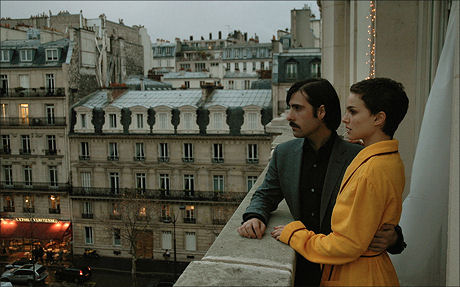
If Hotel Chevalier were nothing but just some short film, it couldn't help but feel incurably slight; if I could only use two words to describe it, they would be "wide" and "yellow". (If there was a word for Peter Sarstedt's "Where Do You Go to (My Lovely)" I'd make that three words, as that song plays nearly non-stop throughout the film.) But it's not meant to stand entirely on its own, and from its attachment to The Darjeeling Limited (it's called that film's "Part One") it musters some heft, ultimately overcoming the fact that ostensibly it feels like it was made as an acting exercise or as a sneaky excuse to get Natalie Portman naked. In the end, it really isn't slight so much as it's subtle and stinging.

In fact, Hotel Chevalier is a pitch-perfect prologue to Darjeeling. The short marks a genuine departure for director Anderson that Darjeeling only hopelessly hinted at; while the visual aesthetic is unmistakable, mostly vanished is his characteristic whimsy and his comedic self-defense mechanism; Hotel Chevalier is naked autoconfrontation, both serious and sad, just short of crossing the line into self-indulgence. The credit for its success belongs to Jason Schwartzman and Portman and their stellar performances; the script is sparing and the dialogue largely unrevealing (though it has its share of great lines: "I promise, I will never be your friend" among them), with all the backstory filled in by gestures between the leads, who obviously spent a lot of time with Anderson developing the characters' histories. The result is a film that needs nothing spoken and yet is still silently and painfully sad. When Portman arrives at Schwartzman's hotel and he jerks away from a kiss, it speaks volumes more than a subsequent exchange:

"Are you running away from me?" Portman asks of Schwartzman's holing up in the French hotel.

"I thought I already did," he answers.

---

The short can be downloaded for free on iTunes, seen in theaters before The Darjeeling Limited (and presumably on the coming DVD) or you can watch a clip here, though beware it's terribly cropped. (The original is noticeably wider at 2.35:1.)

05 November 2007

The Darjeeling Limited

Full credits at IMDb

Directed by: Wes Anderson
Written by: Wes Anderson, Roman Coppola & Jason Schwartzman

Watch the trailer

Grade: A-

The Darjeeling Limited opens with Bill Murray racing to catch the film's eponymous train but, for better or for worse, he doesn't make it. It's a clever little in-joke from Anderson, who has featured Murray in his last three films (and as such could be credited with reviving and redefining his career, Lost in Translation be damned)—Murray has missed the train and, in effect, missed the film. Outrunning him, however, is Anderson newcomer Adrian Brody, who with the legs of a healthy young man hops aboard the moving train and thus sets off the film.

Despite Murray's subsequent absence from the film, The Darjeeling Limited doesn't exactly mark new territory for Anderson; it's more like Wes on holiday, his defining motifs relocated to the Indian countryside. There's the characteristically meticulous mise-en-scene, for example, though it's tough to tell whether it's a result of Anderson's design or if that's just what India is actually like, and perhaps what attracted Anderson there in the first place. The Darjeeling Limited is a train trip travelogue, making the occasional stop for a set-piece or set-up. But it's also, like his last two films, The Royal Tenenbaums and The Life Aquatic, about family reconciliation, centered around three estranged, contentious, chain-smoking, analgesic-addict brothers, played by Brody, co-screenwriter Jason Schwartzman (Rushmore) and Owen Wilson. (In Wilson's first film appearance since his attempted suicide, he is made-up, in a striking coincidence, as bruised and bandaged.)

"I wonder if the three of us could've been friends in real life," Schwartzman says, pointing out the compulsory nature of family ties. But Wilson isn't so cynical; "I want us to be brothers like we used to," he says, and so he takes them all out on a locomotive odyssey through India, a supposed-to-be spiritual journey, with the aid of his assistant, Wallace Wolodarsky, who in supplying the laminated itineraries and essentially planning their trip makes a neat little stand-in for the fastidiously controlling director. (At one point, he even vocalizes the symbolism of a scene to the brothers, as a director would likely do, though off-camera of course.) Wolodarksy and Anderson also have a bit more than a passing physical resemblance.

When the bickering brothers are inevitably booted from the train, they lose Wolodarsky and in tandem Anderson's characteristic whimsy dissipates, the film ultimately stumbling upon tragedy in a Day-Glo toned village. After the 86ing from the train, the cute but combative rapport between the brothers gives way to the root cause of their antagonism, a difficulty in dealing with the loss of their papa a year ago and the abandonment of their mother in the time they needed her the most. Aesthetically, The Darjeeling Limited is a film of ins and outs and backs and forths, underscoring the circular path of the brothers' emotional states as they refuse to deal with the death of their father. (It's also full of Kinks tracks off of Lola vs. Powerman and Money-Go-Round, Part One and helped make that album more accessible to me than it's ever been.)

The Darjeeling Limited has an undercurrent of emotional maturity beneath its hipster eccentricity; Wilson's copious bandages are in fact a manifestation of his deep psychological scars. "I've still got some more healing to do," he says, looking at his gruesome wounds in the mirror and speaking in double entendre. The Darjeeling Limited rightly recognizes that the problems of life are too complex to wrap-up neatly in a mere ninety minutes. Walter Chaw at Film Freak Central gets it right when he says that the film is, "about growing comfortable with being lost."

"We'll never get over it," Anjelica Huston, as the long-lost mother, says to her boys. "The past happened. But now it's over, isn't it?"

"Not for us," Wilson replies, speaking for his brothers. But The Darjeeling Limited is, thankfully, a movie about learning to stop feeling sorry for yourself, not about the satisfaction of wallowing in one's own misery (proving that Anderson is a hipster only deceptively); that is, it's not, necessarily, about learning to overcome one's problems—it's not about finding "closure"—but about learning to come to terms with those misfortunes. Appropriately, running to catch their train at the end the brothers are forced to abandon their bags, tellingly their father's trunks; they are literally leaving their baggage behind, but they're still a long ways from home.

29 October 2007

Private Property

Full Credits from IMDb

Directed by: Joachim Lafosse
Written by: Joachim Lafosse & François Pirot

Watch the Trailer (no subtitles)

Grade: B-

Private Property (Nue Propriété, au francais) is conspicuously contemporary-French; anyone who's seen some recent French character pieces like The Bridesmaid or The Piano Teacher should find its aesthetic style familiar, from the digital texture and the long takes to the uncomfortable suggestions of incestuous sexuality.

Private Property moves slowly, focused on developing its characters rather than providing action because the characters are the story and their interaction is all the action you're going to get. Even the most patient and meticulous character portrait, though, must ultimately give way to some brand of narrative excitement, and Private Property is no exception; but when it does so it feels unremarkable, inspiring more of an apathetic "oh" than an involved "oh shit." It's an intimate glimpse into a complicated family unit, a tempered but contentious domestic drama set around the kitchen table and in front of the television, but when it's all over there seems something pointless about having gone through the whole thing, something a little esoteric about the drama. (Note that the most sympathetic character shares the first name of the co-author, a hint of possible self-indulgence.)

Private Property's main redeeming virtue is that it's a fine actors' piece, and most of its complexity comes from the players' glances and gestures. (Grudgingly, in fairness I suppose we could give Lafosse some credit here as well.) Isabelle Huppert, who at this point never disappoints, leads the talented ensemble, starring as a put-upon divorcee with two grown-looking sons, real life brothers Jérémie and Yannick Renier. Her strained and combative relationship with her ex-husband manifests itself in her relationship with her sons, especially Jérémie. She longs for the boys to move out of the house and out on their own so she can sell it and use the money to open up a bed and breakfast with her neighbor and lover, Kris Cuppens, but the sons, led by the headstrong Jérémie, insist she cannot sell the house, forcing her to remain in the role of mother she has occupied resentfully, so it would appear, their entire lives.

If that makes Huppert sound sympathetic in a "do your own thing, girl!" kind of way, it isn't that simple. Huppert confounds our expectations of a materfamilias by not behaving like we might imagine a mother should, namely by putting herself before her children. (Is that an American expectation?) She seems like a woman feeling held back in her life by her family, tethering her to a life, and symbolically a house, that she doesn't and probably never did want. "How long are you going to fuck up my life?" she asks Jérémie. He, like he did in L'Enfant, plays an overgrown manchild, mean and immature as in the opening scene, when Huppert is modeling a new dress in the mirror, he tells his mother, jokingly at least, that she looks like whore.

It's hard to take sides with anyone in Private Property, as all the characters come across as discomfitingly selfish. Speaking of discomfiting, there are some peculiar suggestions of improper relations between Huppert and Jérémie, particularly early on: Huppert pees with the door open as Jérémie passes back and forth, which might not be so bad except that soon after she showers in front of him, with no curtain drawn, as he brushes his teeth and leers at the mirror. The point is, I hope, to drive home the association between Jérémie and his father, played by Patrick Descamps (although that doesn't explain the Bros. Renier shampooing each other's hair in a shared bath); in many scenes, Jérémie seems like more a husband to Huppert than a son, and their fiercely antagonistic relationship, that culminates in an act of indirect matricide, mirrors the one between Huppert and Descamps. The point is that, unfortunately, the sins of the elders are inherited by the children, and one of the final images is of the two parents on their knees literally picking up the pieces...of a shattered glass table, but it's too little, too late.

25 October 2007

Short Film: La Jetée (1962)

Get the full credits at IMDb

Written & Directed by: Chris Marker

Watch the movie

Grade: A


La Jetée (The Pier, or Jetty), in its brief 27 minute running time, plays like a French New Wave episode of The Twilight Zone, though it's singularly unlike anything you'd ever see on television, or even in a movie theater for that matter. La Jetée, best known to today's kids as that movie that tends to pop-up in the first paragraph or two of 12 Monkeys reviews, is a film about memory, told entirely in still photographs, emphasizing the static and piecemeal character of memory, accompanied by voice-over narration—"un photo roman," (a "photo novel") Marker calls it. (Though at 27 minutes it's more like un photo romanette!)

"This is the story of a man haunted by an image from his own childhood," the narrator tells us, the image of a man dying at an airport (sur la jetée éponyme) right before our protagonist's juvenescent eyes. Set in a post-WWIII future, where the Arc de Triomphe has been de-arched, Davos Hanich is sent back in time by his fellow underground-dwelling refugees to find food and energy, or so he's told, since the outside world is a death trap of nuclear fallout and supplies are running low. Instead, he winds up running around with a woman he recognizes from that fateful airport memory. Together, they visit a number of monuments to time: a dissected tree trunk (right out of Vertigo, an objet d'obsession for Marker) and a natural history museum/taxidermist's showcase. As the narrator suggests, it's like a tour through "the museum of his memory".

Ingeniously crafted as both complex in its execution and universal in its pathos, La Jetée is a short, stinging and haunting parable about the destructive nature of the past as idée fixe; Hanich's pleas to remain in the halcyon pre-war era of his younger days ultimately leads to his undoing, captured in an iconic image of an outstretched arm against a tall and strange metal tower. Running away from the present and future, he discovers the hard way that "there was no way out of time." It's a sad lesson for the nostalgic in all of us.

18 October 2007

Paranoid Park

Dispatch from the New York Film Festival
View the full credits from IMDb

Written & Directed by: Gus van Sant
Watch the (Terrible) Trailer but don't judge the film by it.
Try this clip instead, though it's funnier in context.

Grade: A

Early on in Paranoid Park we see its adolescent protagonist, Gabe Nevins, from the rear as he walks towards a bench in an overgrown field to sit down and write something—a memoir? a letter?—that he calls "Paranoid Park". The first half of the film is told mostly in flashbacks, the images enunciated by Nevins as he attempts to piece together the events of his life surrounding the death of a security guard that, for all we know, he may or may not have been involved in. Mixed into these subjective sequences are objective presentations of the present, in which Nevins wanders, writing.

Mid-way through the film, we see Nevins, who by the way is, like the rest of the cast, a non-professional and perfect for the role, walking out of the aforementioned field, this time from the front. It's a reversal, Van Sant telling us he's about to backtrack, and indeed the film does go back to the beginning of Nevin's story to fill in the holes he's left as a repressed and in denial—in short, unreliable—narrator. (For example, he glosses right over if not downright ignores the pivotal night in question, when the security guard died. Van Sant amends that, and courageously sets the crucial scene to the least popular part of Beethoven's Ninth Symphony, the choral finale.)

Ostensibly, Paranoid Park is structured as a mystery, but rather than merely seek to answer an unresolved question it aims toward something higher—to reconcile the objective truth to a subjective understanding of it. Essentially, Paranoid Park is an experiment in narrative, two separate but intertwined films that represent a struggle between two opposing narrative strains: the objective image, silently narrated by an omniscient director, and the subjective image, dubiously controlled by the main character. It's also a movie about skateboarding.

But Lordz of Dogtown it's not, and anyone going in as a skateboarding aficionado is likely to be as disappointed, if not embittered, as Kurt Cobain enthusiasts were by Last Days. Since his radical reinvention of self with 2002's Gerry (mind that his preceding film was Finding "You're the man now, dawg" Forrester) as an IFC Bela Tarr (or so I hear), Gus Van Sant has been trying the patience of unsuspecting audiences with long tracking shots and coiling narratives. Or, to put it another way, a way I'm more sympathetic to, he's been wowing audiences with pensive films that refuse to supply easy answers to explain complex situations. Paranoid Park may be a bit more psychological than its predecessors, but it remains stylistically in-line. Contrary to what Jake Miller, Nevins' skater pal, says of the eponymous skate park—"nobody's ever ready for Paranoid Park"—those familiar with Van Sant's recent oeuvre should feel right at home.

Elephant, Last Days and now Paranoid Park together make a neat little triptych of character studies for Van Sant. All three share a fascination with, above all, people; while Antonioni is famous for his use of les temps morts (literally "dead time"), in which the camera lingers on a setting after the characters have left it, highlighting the opressiveness of place, Van Sant has turned it on its head and should be known for his use of les temps vivants, staying on his characters even as they uneventfully travel between scenes.

Van Sant, with cinematographer Chris Doyle, a frequent collaborator of Wong Kar-Wai's, rarely employ deep focus in Paranoid Park; the backgrounds, not coincidentally where the parents often are to be found, are blurred to emphasize Van Sant's distaste for "context". As with Elephant and Last Days, he is directly concerned only with the what and not the why. In fact, some of the most gorgeous shots in Paranoid Park are the sequences of Nevins walking through his high school's corridors, a motif familiar from Elephant where it was no less beautiful, and one sequence in particular that plays out in slow motion, accompanied by an Elliott Smith song ("The White Lady Loves You More") that has never sounded so beautiful, is downright ravishing. (It's a nice little nod to the late Smith, a Portland native, who rose to albeit brief popularity off of Van Sant's questionable exercise in mainstream cinema, Good Will Hunting.) Credit for the aesthetic satisfaction is due also to Doyle who upholds the high standard set by Harris Sevides in Van Sant's last few films.

At a Q&A after the Paranoid Park screening at the New York Film Festival, Van Sant said he was trying to make a "young adult film," (after being tactlessly accused by an audience member of making a "hipster horror film") and Paranoid Park is certainly a subtle and painful portrait of high school life and romance. By the end, the soundtrack is dominated by bouncy Nino Rota tunes that recall certain Gershwin arrangements, and Paranoid Park starts to feel, if only briefly, a lot like a pubescent Manhattan.

On a basic level, it's about the universal archetype of the confused high school student searching for an identity, and though it's never explicitly mentioned it could easily be read as a young man's confusion over his sexuality: Nevins wants to spend all of his time with his skater friend, Miller, or at the titular skate park and certainly not with his girlfriend, played in a pitch perfect performance by Taylor Momsen. He even seems a bit vexed by her desire to have sex, and their lovemaking scene is perhaps the most dispassionate I've ever seen. To boot, there is even a suggestive cafeteria scene in which a corn dog might not be just a corn dog.

For all the stress in Nevins' life, whether over his parents' looming divorce, the death of the guard, his needy girlfriend or his uncertain sexuality, there's always a measure of relief in the act of skateboarding. Watching the hooligans ollying at Paranoid Park, a cavernous series of round peaks and valleys, Nevins proves himself wise enough to realize that, "no matter how bad your family life was, these guys had it much worse." But in the skateboarding interludes, filmed in 8 and 35 mms with a slo-mo reverence, Van Sant uses the skateboarders' seeming renunciation of the laws of gravity as a symbol of their freedom, albeit only a temporary liberation, momentarily lost in the air and free from terrestrial constraints and concerns. Skateboarding becomes a manifestation of deliverance, except perhaps in the hidden-camera fisheye lens shots that show cops, with black bars for eyes, writing tickets to the real life Portland skaters. All ollies must come down, just as all repressed memories have to be confronted sooner or later.

--

Click Here to read the minutes of a Q&A van Sant had at the New York Film Festival about Paranoid Park at our sister blog, The Blog Apple.
Death Proof

Full credits from IMDb

Written & Directed by: Quentin Tarantino

Grade: B+ (First hour: A/Second hour: B-)
Watch the Trailer

Death Proof opens on a pair of shapely feet, with polished toes, natch, resting on a sunlit dashboard. Tarantino needn't even bother putting his name in the credits anymore.

On DVD, Death Proof has been divorced from its husband, Robert Rodriguez's Planet Terror, after only a few months of marriage, and "Grindhouse" is no longer a movie, just, at best, a guiding philosophy. So now we have a "Director's Cut" of Death Proof, but it turns out to be too much of a good thing; the "reel missing" titles from the Grindhouse presentation have been replaced by the actual reels, but as it then stands Death Proof feels like it could stand to lose a reel, or all of its second half for that matter.

The first half of Death Proof is damn near perfect, but I suppose it's so good that the film has nowhere to go but down. The first section of the film, sweaty and smutty, is shot in a grainy '70s style, meant to evoke the grindhouse features to which Tarantino is, in a way, paying homage. For good measure, he tosses in some built-in scratches to the film (somewhat analogous to buying jeans with holes already torn in them) and some skittery moments, so that in the end it feels like watching a beat-up print being played through a shitty projector by an asshole projectionist.

Surprisingly, the gimmicks pay off, as they're meticulously incorporated and totally convincing, so that when one character pulls out a cellphone it feels anachronistic. (It's used, though, for the most touching text message that's yet been filmed.) Once again, as in the Kill Bill dyad, Tarantino has managed to create a work of pure pastiche that is still uniquely and unmistakably Tarantino's own. It is tribute as only he could pay it.

A gaggle of short-shorted girlies occupy the film's first half; they're on their way out of Austin to an uncle's lakehouse but first they're going to stop at every decent roadhouse and margaritaville along the way. (I could've stayed in the last bar they visit all movie long, what with all the T-Rex, Joe Tex and Stax spinning on the jukebox, but unfortunately the bar, and the women, are excised from the film Marion Crane style, though at least we get a gruesomely delicious killing sequence.) There's plenty of unmistakably Tarantino dialogue, stylized chick confab with lines like, said in the pouring rain, "it's wet as 'Nam out there!", not to mention that these are all strong and independent women along Beatrix Kiddo lines, while all the guys they meet are whiny, conniving and scummy. (That last point is driven home once you realize that that's scumbag extraordinaire Eli Roth playing one.) It's an important point, since it makes up for, or at least evens out, the surfeit of sexploitation, complete with copious ass shots and a spicy lap dance sequence. They're not strong or independent enough, though, to be able to take on Kurt Russel, who's been tailing them in his pirate-flag-black automobile, complete with a Jolly Roger painted on the hood.

Once the satisfaction of the first half is done and gone, though, Tarantino sort of repeats it, introducing a different but similar group of girls. But the grindhouse gimmicks and '70s markers are mostly gone, and the new cast of women significantly less likable than the ones that went before. The second half of Death Proof feels like a poor decades-later sequel to a cult classic, and the once crackling dialogue now feels forced, particularly coming out of the mouth of Rosario Dawson, who proves herself as able to deliver Tarantino-dialogue as Scarlett Johanssen was able to do prove her talents as comedienne by doing a Woody Allen impression in Scoop. (That is to say, not at all.)

That's not to say, though, that the second half is without its merits; it features a rousing car chase/duel sequence that goes on for more than a reel, for example, and (spoiler) is at least mildly interesting in its reversals of horror movie convention: rather than have a last girl standing, many girls remain standing, and they turn around to attack their aggressor, who flees in panicked terror. I suppose that measure of girl power is equal parts Tarantino and grindhouse tribute, in the tradition of chick revenge flicks, although if Death Proof were really a grindhouse movie I'm sure we would've found out what happened to the girls' friend who, dressed as a cheerleader, they abandoned with a mountain man/grease monkey.