23 January 2008

In Between Days

Full credits from IMDb

Directed by: So Yong Kim
Written by: So Yong Kim & Bradley Rust Gray

Grade: B-

In Between Days is a remarkably faithful chronicle of the teenage experience, especially as, just like those years, it turns out to be so inconsequential. Shot with a handheld digital camera without the use of non-diegetic music, the film tracks Jiseon Kim—a non-professional actress who makes a fantastic debut as a mumbly, mousy teen with a sweet and dimpled smile—over the course of several days in her life as an immigrant living in Canada. It plays out in a series of brief glimpses into her activities: at English class, making dinner, washing the dishes, doodling, riding the bus. But most of all, it’s about her awkward relationship with her best friend, fellow Korean-speaker Taegu Andy Kan, as they buy each other presents, leave each other voice mails, engage in juvenile delinquency, push each other away, make each other jealous, and try just to figure out how to talk to one another.

Though both seem to have some sort of attraction to the other, neither can bring themselves to say it. And so it goes unsaid. In Between Days is about the difficulty of learning how to communicate with one’s peers, particularly those of the opposite sex, while also about the strain in communicating with a culture that isn’t one’s own, one that literally speaks a different language. (Kim and Kan seem brought together by their shared mother tongue more than anything else.) Being a teenager is like being an immigrant, the film suggests; as if each on its own wasn’t tough enough, being both seems impossible.

In Between Days is set, or at least shot, in Toronto, which the filmmakers present as a cold city both in its temperatures, emphasized by the juicy sound of snow crunching underfoot, and in its alienating landscape of metal towers, apartment complexes, highways and chain-link overpasses. Sarah Levy’s heavily Antonioni-inspired cinematography (nod to Gianni Di Venanzo) highlights the marginalized character of Jiseon Kim’s existence, as not only an immigrant facing a language barrier but also as a teenager, with each estranged experience informing the other. In Between Days, as a study of the loneliness of teen age, the uneasiness of being a nonnative and the complexity of navigating the fickle waters of romance, is slight and inconsiderable, but at least it avoids slipping into pretension; it’s sweet, subtle and pointless.

Joshua

Full Credits from IMDb
Watch the trailer

Directed by: George Ratliff
Written by: George Ratliff & David Gilbert

Grade: B-

As the latest entry into the horror subgenre of the “wicked child picture” (eg. The Omen), Joshua covers, by and large, pretty familiar territory, but it at least grounds its story in the ambiguity of reality; there’s no talk of devil spawn, portals to hell or a secret entrance to a witch’s coven behind a closet wall, merely some increasingly nefarious goings-on—only a few dead animals and a crying infant, at first—that may or not be the doing of one weird kid, the film’s eponymous Joshua.

Joshua’s peculiarity is established early on by his affinity for atonal music (which should be enough to send him for counseling), and by a scene a little later in which he tears the stuffing out of his panda doll, mimicking the funeral rites of the pharaohs. “Does he seem like your typical 9-year-old?” his mother, Vera Farmiga (fantastic), asks.

Boasting strong performances from Farmiga (hopefully the performance will be one more rung on the ladder to fame and good roles), as a woman driven madder than her bizarre son by her colicky newborn, and Sam Rockwell as her husband, Joshua still doesn’t quite work because it won’t pick sides; while obviously a horror movie, it tries to avoid being pigeonholed as another mediocre genre film by stressing its domestic-drama aspects. But too often its domestic drama is sidetracked by its stabs at being a thriller—Joshua has a tendency to pop into the frame unexpectedly (BOO!)—while its credentials as a horror film are undermined by the film’s emphasis on the pressures of child rearing.

In its favor, Joshua does make an effort to address intriguing themes; for starters, like its genre brethren it challenges the generally-accepted notion of childhood innocence, and goes even further to question the sacredness of the family unit. Sometimes, children are terrible little things, both the cause and symptom of unhealthy, unstable family units and sometimes families, Joshua suggests, can do more harm to kids, parents and grandparents than good. “All this shouting and this rage and anger,” Joshua’s grandmother says of Rockwell & Fermiga’s home, “you know, that infects a soul.”

But the real terror within Joshua is the creeping idea that family is an artifice, something people tend to hide within to calm their fears of going through life unloved. “You know,” Joshua tells his father, “you don’t have to love me. It’s not like a rule or something.” Are families arbitrary? If we don’t like our parents, can we pick new ones? Joshua’s cryptically threatening refrain is all the more terrifying for not being something commonplace, a threat of violence for instance, but rather: “no one will ever love you.” Now that’s a scary thought.

16 January 2008

There Will Be Blood

Full credits at IMDb
Watch the trailer

Written & Directed by: Paul Thomas Anderson

Grade: A

Though set around the turn of the 20th Century, There Will Be Blood is, in its pitting of capitalism against revivalism, conspicuously more about the state of the union at the turn of the 21st. (There’s even an oilman, or oilboy, called “H.W.”!) Daniel Day-Lewis tears through the film as an oilman, father of H.W. (though the character’s name is Daniel, not Prescott), who picks up a few thousand oil-ripe acres out west—beginning with those belonging to Paul Dano, a young preacher, and his family, in exchange for the promise of a tithe—and starts drilling. Forget films about the American Revolution or the Civil War—this is the true document of the birth of the nation as it stands today, when Texas tea met the Christian church.

Possibly because Day-Lewis fails to let Dano perform a blessing on the first derrick before it starts pumping—“a simple blessing,” he says, “but an important one”—tragedy ensues; soon, an accident sets the derrick ablaze, and through director Paul Thomas Andseron’s lens it looks like hellfire escaping from Hades through a hole in the ground, the devil come to earth with a pitch-black, soaked-in-oil Day-Lewis as his one man welcoming committee. Not that Dano is some kind of saint; not long thereafter, Day-Lewis cuts him down to size by pushing him into a puddle of oil on the ground, a reminder to Dano and to the audience that the two are not so different.

There Will Be Blood announces its grim and somber heft from the onset, through its austere style characterized by uncut long takes, solemnly muted colors and frames packed with sweaty and serious men. (Religion and industry are the domains of men, and as such there is hardly a speaking role for a woman in the film.) Though Dano plays a central role in the film, he can’t help but be overshadowed; There Will Be Blood belongs to Day-Lewis, whom Anderson emphasizes by shooting in unbroken close-ups; but Anderson contrasts this intimacy with a tendency to allow the action to unfold in the frame’s distant rearground. There Will Be Blood is meant to be understood microcosmically, an illumination of one barbarous tycoon in a expansive country full of them, in a world that turns on their dollar.

Although Day-Lewis doesn’t seem like much of a villain at first; not so much cold, callous or cruel, he comes across as simply arrogant. But midway through the film he delivers a speech that clues us in to his bitter and rampant misanthropy, which he has hitherto successfully hidden from his public: “I have a competition in me,” he says. “I want no one else to succeed.” In Anderson’s film, the hubris and greed of unchecked ambition yields tragedy, as Day-Lewis, to his undoing, slips into sin: from lust and drink to abandonment and, finally, murder. At the film’s start, Day-Lewis falls down a crude mine shaft and breaks his leg, though it doesn’t stop him from crawling out, like an animal, to stake a silver claim; he walks with a limp through the rest of the film, his unquenchable yearning for power through money manifest as a physical handicap.

Dano, for his part, is also nothing more than a mountebank, finally exposed, in no big surprise, as nothing more than a manipulative “man of God” out for his own piece of the oil pie. Day-Lewis, like the Cheneyes of the world, co-opts Dano’s religious agenda to push his own oil-money agenda, while Dano forms an uneasy alliance with Day-Lewis to gain control of his small religious community and further his own career. There Will be Blood presents two self-destructive forces, the dominant strains in America—Jesus and oil—as they battle against one another; as a result, the film follows through on its titular promise as one consumes the other, leaving but one: miserable, impotent and alone.

It’s no accident, then, that the film ends during the unraveling of the American Dream known as the Great Depression. If There Will Be Blood begins by showing where the country came from, it moves on to show how it ends. Anderson slyly uses history to predict the future, and to warn Americans that their country is falling in on itself.

10 January 2008

2007: The Year in Film (A Review)

During my midyear review of the year in film, I bemoaned the lack of strong American cinema in 2007. Turns out that American studios were just waiting for the second half of the year to unleash their best work. Curiously, the top three are all Westerns, in their own way.

1. There Will Be Blood


Paul Thomas Anderson's latest uses the past to illuminate the present; set among oil tycoons and revivalist preachers around the turn of the 20th Century, Anderson shows how America's two dominant strains—Jesus and capitalism—are bound to destroy each other and, in the wake, the whole country. The film is a serious and epic piece about American endtimes, but what's more, There Will Be Blood is gorgeous and Daniel Day-Lewis is, no surprise, phenomenal in the lead.

2. No Country for Old Men
(Full Review)


Cormac McCarthy's novel, one of the lesser in his canon but still a rip-roarer, reads like a screenplay in its terse description of action and total lack of psychology, and the Coen Bros. wisely stick close to it in their cinematic adaptation. The only problem: if Tommy Lee Jones' character is so important, why is there so little of him? Anyway, that's easily forgivable: the Coens finally make the most of their filmmaking talents by abandoning their tendency to descend into the zany, and what emerges is an intense, dourly hilarious West Texas crime saga, a masterwork of form and grammar, that eventually sheds its humble genre-ness to shape up into a lesson on violence and American culture. "This country's hard on people."

3. The Assassination of Jesse James by the Coward Robert Ford
(Full Review)


Andrew Dominik's meditation on the dark side of fame, the tragedy of ambition and how criminals become lionized as legends; it's this generation's The Man Who Shot Liberty Valence, with far more poetry and patience, even cynicism. Casey Affleck, the year's best new actor (when considered along with his performance in Gone Baby Gone), doesn't grow up to be a Senator after cravenly killing the badman James; instead, he's doomed to the cruel fate of repeating the cowardly act on stage for the rest of his foreshortened life.

4. Ratatouille
(Full Review)


If we disregard 2006's misfire Cars, we can fairly say that Pixar can not only do no wrong, but just keeps getting better and better. Sure, Finding Nemo may have more sentimentality, Toy Story may have better jokes and Toy Story 2 might have more pathos, but no Pixar film until this one has had such an abundance of all of those traits; it's also a fascinating examination of the artistic process and drive, not to mention populist cinema at its finest.

5. Southland Tales
(Full Review)


There's quite a bit that doesn't work in Richard Kelly's mishmash tale about current events, pop culture and the space-time continuum—foremost, its stabs at comedy (Sarah Michelle Geller excepted)—but what does is astounding. Kelly gets an A for effort, for that scene where Justin Timberlake lip-synchs "All These Things that I've Done," for making two cars have sex with each other, etc. etc.

6. Syndromes and a Century
(Full Review)


More of the same from Apichatpong Weerasethakul, meaning one more fantastic out-an-out redefinition of the medium's potential. It's like one long and confounding dream, beautiful and overwhelming. Its complexity can be frustratingly boggling, but the sheer beauty of its execution is enrapturing.

7. Sweeney Todd
(Full Review)


The bloodiest musical since...well, ever. Sweeney Todd achieves a level of tragedy worthy of the opera hall and addresses America's propensity for war by warning: beware of vengeful impulses because they never end well. It's Burton doing exactly what he should be doing—Gothic horror—while getting a chance to do what he wants to do—a musical, and the result is a wonderful mix of the two informing each other.

8. Day Night Day Night
(Full Review)


Luisa Williams channels no less than Falconetti in her performance as an adolescent suicide-bomber-to-be in Day Night Day Night, a beguiling film that makes no effort to offer any answers to the mysteries it poses, namely: WHY? Despite the edge of your seat tension as she wanders Times Square with a backpack bomb, Day Night Day Night is less about terrorism than, wildly, how tough it is to make it in New York.

9. Before the Devil Knows You're Dead
(Full Review)


What's wrong with America? Everybody's strapped for cash and it makes them do terrible things, like hold up their parents' jewelry store and go on killing sprees. Sidney Lumet finally churns out a solid film after two decades of clunkers, one that, by far, features the best ensemble acting of the year.

10. 12:08 East of Bucharest
(Full Review)


Modest and hilarious, the Romanian New Wave scuttles along with this entry from Cornelius Promoboiu. What if they had a revolution and everyone came ten minutes late? Well, we could argue about it years later. The point of this simple comedy is that sometimes a revolution isn't all it's cracked up to be.

Runners up:
The Darjeeling Limited, Zodiac, The Simpsons Movie, Paprika, Sunshine, Black Book, Triad Election, U-Carmen, Time (Shi Gan)

Best Documentary:
No End in Sight
(Full Review)


Sure to become dated when the Iraq War is, hopefully, just a painful but distant memory, for now No End in Sight is the a straightforward, unbiased breakdown of what went wrong and where to lay the blame. Everyone should see it just to make sure that they understand what's happened thus far.

Best Movie Released Decades Ago:
Mafioso
(Full Review)


This gem out of Italy finally made its American debut earlier last year, though it dates from 1962. What starts out as a culture clash comedy between Northern and Southern Italians becomes a serious exploration of the clash between the safety of modernity and the dangerous violence of old-fashioned living.
(N.B. I still haven't seen The Killer of Sheep!)

Best Cinematographer:
Roger Deakins


From the West Texas landscapes of No Country for Old Men to the plaintive wash-outs of The Assassination of Jesse James... Deakins wins hands down. He's responsible not only for one of the best cinematography jobs of the year, but two.

Best Actress:
Carice von Houten


Von Houten's performance in Black Book as a spy for the Nazi resistance who falls in love with a Third Reicher was on par with those from great movie stars of the past.

Best Actor:
Casey Affleck


He's got stiff competition from the boys of Before the Devil Knows You're Dead, Daniel Day-Lewis and even his Assassination of Jesse James... co-star Brad Pitt, but for putting in two revelatory and top-notch performances this year, in Gone Baby Gone and Assassination..., Casey Affleck wins.

Best Supporting Actress:
Amy Ryan


Ryan's filthy performance in Gone Baby Gone as a strung-out, odiously selfish and yet sympathetic mother added to the film's most redeemable virtue: its keen sense of place. She seems nothing if not pure Boston.

Runner-up: Cate Blanchett, I'm Not There (Full Review). She looks like Bob Dylan—but she's a chick!

Best Supporting Actor:
Hal Holbrook


Just about the only redeemable thing about the abysmal Into the Wild is Holbrook's devastating performance as one of the many people Christopher McCandless abandoned in the course of his life.

Runner-up: Albert Finney, Before the Devil Knows You're Dead. A towering turn as a shaken old man who never liked his son and eventually comes to hate him.

08 January 2008

City Lights (1931)

Full credits from IMDb
Watch the Trailer

Written & Directed by: Charles Chaplin

Grade: A+

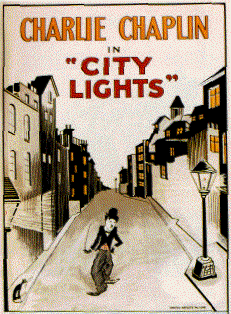
Without looking back, so to speak, at the silent cinema it was gleefully abandoning, moviegoing audiences embraced the novelty that was the "talking picture" as the norm almost immediately upon its introduction. That wasn't enough, though, to deter Charlie Chaplin from sticking with silent movies as late as 1931—when no one was making silent movies anymore—the year he released City Lights, a whole four years after The Jazz Singer had premiered. (Granted, because of his perfectionism, Chaplin's film had been in production for three of those years.)

City Lights makes no secret of Chaplin's faith in the silent film or in his distaste for the talkie; in its first scene, a group of public officials are making speeches to celebrate the unveiling of a new statue—or, at least we can only assume they're making speeches, as we see their mouths moving but Chaplin, as director, has replaced what would've been dialogue with so much amusing squawking. It's a good gag, but it has more serious undertones: he's not only aggressively mocking the talkie, but challenging the value of speech itself. Aren't mere words deficient, Chaplin provokes us to ponder, against the purity of physical expression?

After all, as hilarious as the Marx Bros. or Woody Allen are with their verbal one-liners, no one is, comic pound for comic pound, as belly-bustlingly uproarious as Chaplin. (Sorry folks, not even Keaton.) But as Chaplin demonstrates in City Lights, nor are most filmmakers capable of producing such a startling degree of poignancy. Not only is City Lights incontestably hilarious—rarely, in the movie theater (where I was fortunate enough to see the film recently), does one get to hear the strange sound of people laughing from the gut for so long—it's perhaps the purest example of the cinema's potential for pathos.

City Lights is constructed as a series of slightly interrelated vignettes, each a modest masterpiece of moviemaking in their inventive uses of form, comic timing and romantic expression. Together, they add up to filmmaking at its very best, the unadulterated visual expression of high-end slapstick flawlessly combined with the most basic, and most powerful, elements of love and romance. The two comic highlights of the film are two bonafide tours-de-force: an extended nightclub sequence with the iconic Tramp and a drunken, suicidal millionaire in which one hilarious gag follows another, and a brilliant, balletic boxing sequence that, as it's unedited, proves to be a triumph of complex comic choreography; Chaplin's comic sequences are not just a whole bunch of jokes thrown together all higgeldy-piggeldy, but they're each like one big, overarching master joke, constructed like short stories with each gag building on one another like sentences in a paragraph.

But balancing out the laughs is a serious story (even though it still provokes the occasional joke) about the tramp's courting of a blind flower girl who mistakenly believes him to be a rich man. In the end, City Lights is, like Annie Hall, less a comedy with a romantic side than a romance with comic highlights. I never cry so sincerely or so much at the movies than during the end of City Lights; all summed up in its final shot or two, it's the movies at their most tender and satisfying.

07 January 2008

The Orphanage

Full credits at IMDb
Watch the trailer

Directed by: J.A. Bayona
Written by: Sergio G. Sánchez

Grade: B

Seeing as Guillermo del Toro produced J.A. Bayona's The Orphanage (El Orfanato)—and since his name is slathered all over the advertising—I think it's only fair for us to run through the "essential elements of a del Toro movie checklist," via The Devil's Backbone and, to a lesser extent, Pan's Labyrinth, to determine how much of an influence he may have had on the film. Do we have an imaginative, wide-eyed kid? Check. How about a contrasting creepy-looking kid? Check. A cavernous underground space, like a cave or a basement? Check, check. Really? What about a remote country house? Check. How about the accidental drowning of a child? Check. Well then, sounds like a del Toro film to me; all that seems to be missing is some mention of the Spanish Civil War.

Alackaday, there's no backgrounded war in The Orphanage; in fact, there isn't much sense of the setting at all, beyond the eponymous orphanage's property lines at least. Without that sort of context, historical or otherwise, The Orphanage, to its detriment, is tough to pin-down up until the very end, if at all. When a young boy goes missing and his mother, Belén Rueda, comes to believe that he was taken by the ghost-orphans that may or may not haunt their home—a former orphanage—the film seems headed toward serving as an allegory about injured ghosts (of history? that might make sense) that need to be satisfied and put to rest so that future generations—our children's—may thrive. It plays out as a classic tale of the return of the repressed, save for one little thing, that is: our hero, Rueda, hasn't repressed anything! Any grievances these ghosts might have don't have anything to do with Rueda who, while once a resident of the orphanage, was adopted and spirited away before the nefarious goings on, which might merit revenge, that we discover to have occurred.

The filmmakers seem to be trying to leave it up to us whether the film is meant to be taken symbolically or not, but if we were to take it that way it wouldn't make any sense. So rather than function as ghastly historical allegory, then, I suppose The Orphanage shapes up to be, with a debt to 1961's The Innocents, a mystery more psychological than paranormal, an expressionistic tale of a woman gone mad after the disappearance of her son. "I'm not crazy," Rueda roundly declares, but it's tough to believe her; after all, isn't it perfectly plausible that a woman who has lost her dear child might just be imagining that her house is haunted by a gang of school-aged ghosts who've kidnapped him? More so than believing the ghosts to be real, anyway—no? As a psychic medium tells Rueda, "seeing is not believing, it's the other way around." With that maxim in mind, as in Pan's Labyrinth, the film's happy ending is thankfully only deceptively so (though to make it a question at all is arguably a cop out)—that is, a happy ending ought only to be seen by those who believe that they're seeing a happy ending. But the filmmakers don't seem to realize there's two kinds of ambiguous filmmaking: the cleverly so, like the ending, and the slipshodily so, like the preceding eighty or so minutes.

Starting Out in the Evening

Full credits at IMDb
Watch the trailer

Directed by: Andrew Wagner
Written by: Fred Parnes & Andrew Wagner

Grade: C

Curiously starting out in the daytime, Starting Out in the Evening at least gets right down to it; in an efficient diner scene, the basics are quickly established: that Frank Langella is an ailing writer with four books out of print, that Lauren Ambrose is a go-getting grad student writing her master's thesis on his work, and that they're about to embark on developing a complex relationship. If only the rest of the film were as crisp as its first scene; instead, it ambles about, not exactly sure of what it's about or what it wants to say. A potent conflict between an aging writer and his young student is lost amid the clutter, too often undermined by a saccharine score, diminished by dreadful lines like, "maybe the characters in your books have the luxury of grappling with moral issues, but I'm in the real world," and side-tracked by a worthless subplot involving the rote and lame romance between Langella's daughter, Lili Taylor, and her boyfriend Adrian Lester. (No disrespect to Taylor as an actress, but plenty of disrespect toward the filmmakers for creating such a whiny and tiresome character.) It's the sort of sloppy film in which a character looks at a photograph and, for our sake (oh don't bother!), speaks to it. "Where are you?" Ambrose stupidly asks a photo of a young Langella.

Last year, Langella bowled over New Yorkers, and tourists too I suppose, with his blustering and commanding performance on Broadway as Richard Nixon in Peter Morgan's Frost/Nixon. His performance here is far more painstakingly dignified and composed, but no less titanic; unfortunately, like his aging, fading character, the surrounding film lacks focus, drive and, most of all, enthusiasm; in effect, his performance goes wasted. Somewhere buried inside Starting Out in the Evening there's an intelligent and fascinating film about aging, relationships and the artistic process, but for every genuine or cleverly subtle moment there is another that rings twice as false or twice as loud. Its worst crime is that the filmmakers apparently truly believed they could add depth to Langella's story by telling it parallel to a yawn-inducing tale of an unlikable couple's fundamental disagreement over whether or not to have children.

If Starting Out in the Evening were much shorter, it would be more easily forgivable; as Nathan Rabin recently wrote, "I always appreciate movies that end after seventy-five or eighty minutes. It’s as if they’re saying 'Look, we know we aren’t very good. But we won’t take up too much of your time. In fact we’ll let you go fifteen minutes early so you can get on with your busy life.'" With its subplots and strolling pacing, though, Starting Out in the Evening unnecessarily pushes the two hour mark, and what was merely a nuisance of a film becomes, as the running time improbably drags on, aggressively irritating. As Rabin continues, "movies that linger past the two-hour mark are like teachers who keep you after school."

Most infuriating of all, Starting Out in the Evening seems fully aware of its shortcomings, as it blithely criticizes itself throughout. Lester describes one of Langella's books as "soft and sentimental...it's one of those relationship books, two couples and all their problems and all of that, yadda yadda yadda." Are the filmmakers really so dense that they fail to appreciate that that's what wrong with their film, or do they think they're being cheeky while proudly staying above the put-downs? Do they really, I mean really, think their film is better than that? "Following your characters takes time," Langella says of his writing method; yeah, but it shouldn't take this long. Finally, Langella laments, "my characters haven't done anything interesting." Phew, you could say that again.

01 January 2008

Atonement

Full credits at IMDb
Watch the Trailer

Directed by: Joe Wright
Written by: Christopher Hampton

Grade: B+

At the very least, director Joe Wright, together with screenwriter Christopher Hampton, can be commended for fashioning a remarkably efficient filmic adaptation out of Ian McEwan's titanic tour-de-force of a novel; what takes McEwan 300 pocketbook-sized pages to accomplish, the filmmakers knock off in 45 minutes, without sacrificing too much substance that it would offend the book's fans. McEwan's novel is thoroughly internal and deeply psychological, but the filmmakers turn it into a tale of both revealing gestures—the film is full of close-ups of hands, whether furtively brushing beneath a table or spooning sugar into coffee—and pithily significant remarks. In short, they make it cinema.

But Atonement: The Movie has more to offer than mere efficiency. Opening in the English countryside during the build-up to WWII, the film shows no sign of any expense having been spared in its pursuit of visual opulence; it's a gift to the senses, with the lush feel of a grand, old-fashioned period piece. Thankfully, however, it replaces that genre's characteristic stuffiness with pulsating vitality. The sense of 19th Century, Victorian propriety is undercut by a throbbing 20th Century sensibility of violence and sexuality; the film is propelled forward by a quivering lust that appears in nearly every character's glance. (Fine performances are delivered across the board.)

In one ravishing sequence—and the film is full of lavish visuals—Wright cuts between his two central lovers, played by James McEvoy (phenomenal) and Keira Knightley (excellent) as they prepare for dinner; Wright soaks the halcyon country life in a sunstreaked, smoky haze and the gorgeous glow of nostalgia, but he soon punctures the film's misty romance by confronting us with that most vile of English words, cunt, being spelled-out on a typewriter. (Welcome to the 20th Century!) As a tale of love and misunderstanding, Atonement's first half could easily be reworked as romantic farce; instead, the story unfolds as tragedy, exposing a world in which repressed veneers of propriety lead not to healthy sexual expression but to rape (statutory at least), and where disjoined lovers find not reunion but the rampant destruction of the second World War.

By leaping, midway through the film, a few years into the future to find our hero on the march to Dunkirk, Atonement suggests that its central romance is so troubled that it rivals the failed Anglo-Franco resistance to the German invasion of France. The wartime violence isn't excessive but is still unsparing, from the discovery of a field full of schoolchildren's lined-up corpses to the systematic assassination of horses at Bray Dunes. (The uninterrupted tracking shot upon our hero's arrival at the Bray Dunes is a masterpiece of form and the year's most technically impressive sequence.) The colors go muted in the film's second half, though the light remains brilliant, and the haze that was once so romantic takes on a character of menace. Gradually, love is smothered by war.

McEwan's novel is told in three spatiotemporally distinct sections, each with tremendous cinematic potential. (As though begging to be set in celluloid!) Hampton, however, by necessity—for the sake of a trim and decent running time—pares down the novel's latter sections, especially the second, and as a result the film's three segments, taken together, don't quite add up properly; by retaining the novel's tripartite structure but stripping some of those episodes' narrative purpose and intensity, the film winds up feeling flighty and unfocused. Why, exactly, are we in France during WWII? Or a London hospital?

Finally, McEwan's subtext about the nature of artistic creation, namely its ability to improve upon the dreary misery of real life, feels incongruously set within the film's romance; by trying to stay too faithful to its source material, Atonement winds up a bit muddy. Some novels just won't make good films, but if Atonement just had to get made as a feature film, I don't see how Wright and Hampton could have done it any better. From its settings to its leads, it sure is pretty, at least.

Persepolis

Full credits at IMDb
Watch the trailer

Written & Directed by: Vincent Paronnaud & Marjane Satrapi

Grade: B-

Over the last decade or so, comic books, as a medium, have assumed a position of cultural legitimacy under the banner of the "graphic novel," becoming a respectable, and commercially viable, form in which artists and writers can tell the stories they want to tell. Comics no longer have to be aimed at children, nor must they only concern the adventures of superheroes anymore; they can now be about ordinary people and ordinary life—just like ordinary novels.

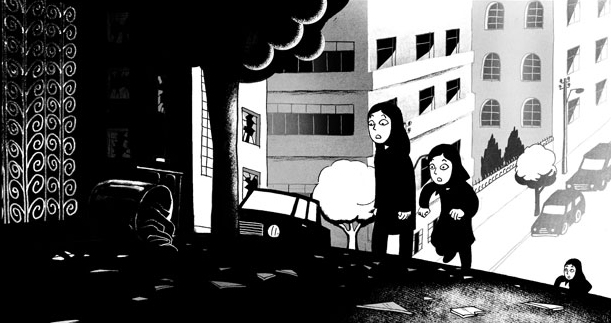
The animated Persepolis marks the graphic novel's transition to the world of movies; it's not the first non-fantastical comic to be adapted to the big screen—the live-action Ghost World immediately pops to mind, as do A History of Violence and The Road to Perdition—but perhaps the first to be adapted, visually, from page to screen so faithfully. By retaining its source material's black-and-white aesthetic simplicity, Persepolis plays like a comic book, er graphic novel, in motion, and not like a film merely "adapted from" one. Its origins are unabashedly conspicuous.

Not least of all in its fluidity, the animation, particularly that of two wormlike women who condemn our hero's Michael Jackson button, vaguely recalls the Fleischer Bros., like a Betty Boop cartoon with a bit more verisimilitude in the character design. Its hand-drawn style, even if it doesn't all look hand-drawn, is a welcome change of pace, no matter how stunning Pixar's films are, from the turn to computers that's dominating the animation industry. (Disney doesn't even employ animators to animate by hand anymore!)

Unfortunately, the shallow depth of field of its two-dimensionality reflects the flatness of its story, which concerns one woman's experiences growing up in Iran. Creator and co-writer/co-director Marjane Satrapi tells us her life story, first of herself as a young girl before the overthrow of the Shah, later as an adolescent during the country's increasingly restrictive turn to Islamic rule, then her life abroad and finally back in Iran. (She now lives in Paris, though that creeps into the film only marginally.) Satrapi feels a stranger wherever she goes, not fitting in under the oppressive strictures of Iran nor adapting to the relative freedom of Austria, where it only takes simple boy problems—and, in fairness, some encounters with racism—to provoke her undoing. (The point being that shit sucks, albeit for different reasons, no matter where you go.)

Satrapi proves a sympathetic everywoman, even in her relatable moments of vanity and selfishness, but there's nothing truly fresh, remarkable or provocative about her coming of age tale; the only aspect that provides any bit of distinction is that she's Iranian, but that fact alone is not enough to raise the tale above the level of boilerplate misadventures in search of an identity. Added to what Noel Murray calls its "and then this happened" structure, Persepolis, despite its inventive and pleasing animation, drags on dully.

Not to mention that it's uncomfortably conceited, not only in its reduction of the surrounding political turmoil to its effects on one woman—since we don't meet many Iranians outside of her simplistically noble family, she doesn't serve as much of a universal representation of a people; it is less the tale of Iran told through one woman than the tale of one self-absorbed woman incidentally set in Iran—but also in the very fact that she's telling us her story at all. (And not least of all in the fact that she presents her young self as a prophet with a direct connection to God!) At root, Persepolis' narrative arc is as simple as this: Satrapi grew up, felt out of place everywhere, and eventually got over it, though not entirely; couldn't anybody on the street tell a similar story? Oh, did I mention that it takes place in Iran, though?

26 December 2007

Once

Full credits at IMDb
Watch the Trailer

Written & Directed by: John Carney

Grade: B+

Once opens with real-life singer-songwriter Glen Hansard (of "The Frames") busking on a Dublin street corner while a pissed-up bloke pisses in an adjacent alley; if this is going to be a musical, then it sure as hell ain't Vincente Minelli behind the camera. It turns out that Once is a musical, naturalistically shot with a shaky handheld, one that stays true to the romantic core of the movie musical and its MGM standards while stripping away its artificial pretensions, particularly its penchant for unaccompanied spontaneous singing: its characters may break into song, but they do so because they're musicians, and they only do so with their instruments, or at least their discmen, in tow.

But you might say Once is deceptively natural as, while it may present an imperfect world, it's unfailingly pleasant, constructing a universe in which able, willing and available musicians occupy the streets like ripe apples in an orchard, simply waiting to be plucked, and everyone—from parents to loan officers to recording engineers—is just dying to help make one's dreams come true through support and cooperation; where all it takes to succeed is a generous helping of talent and charm. If not in its style, then at least in its story Once is a standardly romantic and fanciful musical. Hansard and Markéta Irglová, a classically-trained pianist/flower girl with an Eastern European accent, meet cute on the corner one evening when he's banging his guitar and screaming his little head off; she's an Eliza Doolittle figure and Hansard's her Higgins, except he doesn't want to tease a proper English accent out of her—though she could use one—but rather draw out her musicality.

As Rogers and Astaire expressed their feelings for one another through dance, Hansard and Irglová express their budding emotions not through a kiss—or, heaven forbid, lovemaking—but through music, through vocal harmony and guitar-piano interplay. Together, they're two musicians for whom life is a folk opera with little room for unsung speech; when they try and explain themselves through dialogue, they fail to connect, but through their instruments they transcend the divide of spoken language (her Czech is better than her English) to find common ground in the shared vernacular of indie rock love. Over the course of a week they feel out each other's musical styles, recruit a band of street musicians, record a CD, and then go their separate ways. It's cute but not aggressively so, emotionally subtle and secure in its simple sweetness.

Hansard and Irglová, both non-professional actors exuding high levels of charming sincerity, aren't your typical movie lovers: he's hung up on an old flame and she's the mother of a small child and married to a man back in Czech Republic, though they're estranged. While your typical movie musical uses music to bring two innocent young lovers together, Once uses two young lovers to bring its music together; when the demo is done, the lovers split. Rather than a kiss goodbye, in keeping with non-physical character of their relationship, the parting gift is a piano, and that musical connection means more than any smooch ever could.

Hannah and Her Sisters (1986)

Full credits from IMDb
Watch the Trailer

Written & Directed by: Woody Allen

Grade: A

Hannah and Her Sisters is one of Woody Allen's many penetrating cinematic analyses of the contemporary culture and his own kind: affluent, intellectual and neurotic New Yorkers. It might be his finest as well, although with such a strong catalog of films it's difficult to ascribe such superlatives to any individual Allen movie.

The film, a masterpiece of ensemble acting—Allen's mastery as a director of actors is often and unfairly overlooked—is built around a collection of spouses, siblings, friends and in-laws on the cusp of mid-life crises, each with a conspicuous lacking of varying kinds: Dianne Wiest, who steals the show with a performance so palpably nervous, insecure and strung-out that it approaches Woody Allen levels, lacks the direction of a career or relationship; Allen himself lacks the comfort and security of spiritual certainty; while Michael Caine, who won an Oscar for his performance, and Barbara Hershey lack romantic satisfaction in their respective relationships. It lunges them, ultimately, into an affair, following an awkward courtship (brilliantly executed), even though Caine is married to Hershey's sister, the titular Hannah (Mia Farrow).

Beginning at one Thanksgiving, that American, non-denominational celebration of family togetherness, and ending at another—with one more in between—the characters set out on chaotic, destructive attempts, doomed to failure, to fill those voids in their lives. The character arcs follow a parabolic trajectory: a plunging descent into abjection, followed by a redeemed return to originating normalcy. It is at once distancing and inviting, alternatingly pushing us away with its alienating chapter titles and drawing us in with its intimate, multiple point-of-view voice-over narration, a parallel to the characters' vacillating behavior towards one another.

One of Hannah and Her Sisters' driving dilemmas is, is "finding the right person" so important that it morally permits the destruction of families and the devastation of individual people? Though released before Allen's very public personal troubles, as a tale of interfamilial infidelity and betrayal Hannah and Her Sisters is, in hindsight, a personal working through of this question for Allen, a veiled, disturbing and piercingly autobiographical confessional of lust and domestic dissatisfaction. It seems, now, no accident that Allen cast himself as Farrow's ex-husband and she as an actress garnering raves for her portrayal of Ibsen's Nora; it seems as though he was practically begging Farrow to get the hint and leave him before he lost control of himself, advice that unfortunately went unheeded.

Though everyone gets a happy ending in the film—or at least deceptively happy, as it's tough to believe any of these characters could have lasting and meaningful relationships, evidenced at least by the ambiguously optimistic revelation that concludes the picture—Hannah and Her Sisters preaches that getting love right takes a couple of tries. "Boy," Allen naively observes in the film, "love is really unpredictable." The film is rife with divorcees and relationships that are like drinking glasses teetering on the edge of a coffee table, waiting for one slight push to send them on a shatter-bound course to the floor. Even the relationship between Hannah and her sisters' parents, a superficially pleasant and loving old couple with a seemingly happy marriage enduring through the decades, is exposed as a mere front behind which a couple of bitterly jealous and contemptuous old-timers have hidden their animosity and extramarital trysts for years.

But Hannah and Her Sisters concerns more than the mere crises of the heart and body, branching out to explore a crisis of the soul as well. (Allen would expand on this religious-philosophical aspect in his subsequent masterpiece and Hannah's companion piece, Crimes & Misdemeanors.) Allen plays a hypochondriac whose brief confrontation with mortality sends him hurtling on a seriocomic quest for meaning, including a stab at Catholicism that hilariously manifests itself in the seemingly compelled purchase of not only crucifixes but Wonder Bread and Hellman's. Despite its levity, the spiritual journey builds to a gorgeous and moving climax in which Allen, in a moment of rock-bottom despair, unlocks the meaning of life via a screening of Duck Soup. The secret to enjoying life, Allen tells us, is in finding the strength to enjoy living, God or no God, lover or no lover. It's a much needed lesson for any Woody Allen character—any modern human being, that is.

Before the Devil Knows You're Dead

Full credits at IMDb
Watch the Trailer

Directed by: Sidney Lumet
Written by: Kelly Masterson

Grade: A-

After at least a decade, if not much more, of lackluster films from Sidney Lumet, the fading titan has strikingly returned to form with a fiery, blustering crash. Before the Devil Knows You're Dead is easily the best-acted film of the year, but what's more is that it's a sharp piece of cultural criticism about late capitalism and the depths of tragedy it's capable of producing.

Nearly three-quarters of the way into the film, Marisa Tomei asks her husband, played by Philip Seymour Hoffman, for car fare to her mother's house; "I could really use some money," she says, and she might as well be speaking for every character in the film. Before the Devil Knows You're Dead is about money, pure and anything but simple: its role as America's driving force, main object of desire and the one thing of which no one seems to have enough.

Hoffman is introduced in a position of dominance, retrocopulating with his wife Tomei (it's surprisingly graphic, despite being filmed in a non-revealing long shot), a dominance he'll resume, though not in a porously-penetrative way, throughout the rest of the film in regards to his little brother, played by Ethan Hawke. Hoffman pushes him into a robbery he doesn't want, nor have the brains, to commit but both, to their undoing, are in desperate need of the cash they assure themselves that they'll score. (And Hoffman, the cokeheaded corporate exec, is too much the coward to do it himself.)

Hoffman is obsessed with the pathetically unrealistic idea that if only he could get he and his wife back to Rio, where they spent the opening scene in giggly, orgasmic bliss, they could solve all of their marital (er, sexual) woes. "I need money," Hoffman says, "I want to start over again." Meanwhile, Hawke is in debt to just about everyone he knows and not only can't he pay his child support, he can't even afford to follow through on his promise to his daughter to send her on a field trip to see The Lion King on Broadway, humiliating her with his poverty in front of her entire grade-school class.

United, then, by a shared indigence, Hoffman enlists Hawke to rob a Westchester jewelry store, a mom-and-pop operation in the most literal sense, as their parents own and operate it. This is the sort of premise that comic films are made of, but Lumet and screenwriter Masterson play it straight. (They take a moment to laugh only once, at a mildly ridiculous costume that Hawke dawns on the day of the robbery; Lumet seems prone to finding comedy in costumes, as the only other time I can recall him making a successfully funny joke was when Al Pacino showed up in Serpico absurdly dressed, for no specified reason, as a hasidic Jew.)

Hawke is initially uncomfortable with the idea of knocking off his parents' joint, making excuses to his domineering big brother. "I got a kid," he whines. "You got shit," Hoffman counters, correctly. That oppressive need for dough that the brothers share sets into a motion a tragedy that, like its characters debts and obligations, builds and builds until each player in the tragedy is left shattered. It's just one harrowing thing piling on top of another, until the pile's too deep to be dug out from under, Lumet suffocating the characters and audience alike.

No one does straight formal filmmaking—not to mention direct actors at an Elia Kazan-level—like Sidney Lumet. (Pronounced Luh-mett, by the way; as Foster Hirsch says, "he's not French, he's a Jewish kid from Brooklyn!") Having gotten personal flair out of his system as early as 1964 with The Pawnbroker, Lumet, in his directness and faithfulness to his source material, is a screenwriter's best friend. Having come from television and the theater, Lumet comes to cinema with the old-fashioned idea of the text as king. Disregarding a few editing flourishes that take us through the film's jumbled temporal structure, Lumet's style is the epitome of directorial restraint.

Though that's not to say that he's pejoratively "by the books," just a director in total control and, at his best, comfortable enough with his own talents and story to avoid making any misguided attempts at overextension. (Though it should be noted that despite his capacity for mastery he's had more, much more, than his fair share of clunkers.) An extended long take of Hoffman unfastening his shirt's buttons and fixing himself a drink is a testament to Lumet's brilliant filmmaking patience, while the Looney Tunes short playing on the television in the background is a nice touch, suggesting the silliness and cartoonishness of Hoffman and his big robbery plans.

But Lumet never lets the film descend into the zany—thankfully, as the director barely has a funny bone in his body—keeping it soaked instead in hard-boiled, absurdly depressing high-cynicism. The story moves back and forth through time, switching points of view using the robbery as its center; the crime itself, which of course goes horribly awry, begins the film and serves both as a repeated point of return or departure for the various narrative strands. I understand that the technique is meant to underscore the characters' detachment from one another—the filmmakers refuse to even let their narratives proceed together!—but the gimmicky structure detracts a bit from the film's central narrative thrust; as the story winds down, though, and the characters become more and more tied up in one another, the filmmakers allow the competing strains to integrate. In its last act, the characters, united, place a period at the end of the grim parable.

At the film's heart are three clashing males: Hawke, as a man-in-debt way in over his head who can't drink or steal his way out of it, gives his most impassioned and dynamic performance to date, certainly coaxed out of him by the masterful Lumet, while Hoffman is, at least at first, a bit more restrained, going from giggling through his role to becoming a man gone mad, having entirely fallen apart. Both actors are phenomenal, but trumping them all is Albert Finney, channeling the spirit of Peter Finch (who got himself an Oscar thanks to Lumet), as the boys' father. Hoffman maintains control over his dimwitted little brother, but Finney controls them both; as his character of the weepy and angry old father dominates his sniveling children, so too does Finney dominate the film. From all sides, Before the Devil Knows You're Dead is full, in bursts, of loud, conspicuous emotions as the dramatic intensity unceasingly increases. But those emotions never ring false or stink of misguided overacting; they maintain a startling level of emotional genuineness, the performances unsettlingly naturalistic.

Though Before the Devil Knows You're Dead presents an America totally fucked by debt, it still maintains that crime doesn't pay. Crime is just about the worst route, in fact, in this punishing, unforgiving film without the faintest glimmer of hope or moral direction in which every plot point is another crank of the vise around the audience's throats. "The world is an evil place," a jewel-fencer says, declaring the film's theme. "Some of us make money off it, others get destroyed." So you might as well swallow a bottle of pills now and get it over with. In his cranky cynicism, but not in the freshness of his direction, Lumet is showing his age.