31 May 2008

Reprise

Directed by: Joachim Trier
Written by: Joachim Trier & Eskil Vogt
Full Credits from IMDb

Grade: A-


Reprise opens with a narrative catalyst most mundane, cinematically: two friends, Anders Danielsen Lie and Espen Klouman-Høiner, drop their unsolicited manuscripts, first novels, into the post. But Trier, a distant relative of Lars von, has no intention of letting his film be so dull; the next reel goes through, what would be if it weren’t cut off, an infinite number of imagined possibilities, narrated in the conditional tense and commented upon by the would-be authors’ animated dust jacket portraits. Dizzyingly circular and endlessly digressive, every visual in Reprise only serves as an excuse to conjure up another—a childhood memory, a fantasized future. In short, the film screams with Godardian playfulness; Georges Delerue’s “Theme de Camille” from Contempt pops up in the first reel not merely for its lush beauty.


Trier’s mad obsession with his subjects matches the characters’ own self-absorption, while the wandering filmmaking reflects the myopia and impermanence with which his characters live their lives. Lie and Klouman-Høiner, as well as their handful of pals, together constitute a quintessential group of young literary friends; they spend their time, or so we’re told, reading and writing, but also possess an almost Apatovian knack for mockingly needling one another. We’re meant to deride both their intellectual pursuits—the modeling of their lives on literary conventions that causes one girlfriend to explode: “you’re such a damn cliché!”—and their abusive prattle as symptoms of their arrested development, though the filmmakers also scorn “growing up,” in the bourgeois sense of settling down—wearing sweaters, throwing white-linen dinner parties. Reprise does not allow its characters to follow an easy arc from puerility to maturity, even questioning the possibility of whether such an arc, simple or difficult, exists.

Instead, Trier offers a meandering film about men meandering for meaning. That’s not intended as insult; Reprise boasts an alluringly, indismissibly romantic world view of scattered pillow-feather revelry, in which writers need hardly spend anytime writing—they simply publish books and, most seductively, hang out with the boys. Like last year’s Superbad, Reprise captures that male yearning for the fraternal bond that dissolves with age, replaced, with ambivalence, by the sexual, female bond. Klouman-Høiner’s novel is about, he pretentiously declares on television, looking for a universal language with which to make sense of the world, reflecting he and his friends’ central problem: that they try to make sense of their lives through books and words, by using their heads. Women, on the other hand, trite as it sounds, use their hearts. Though thoroughly a “(thinking) man’s movie,” Reprise (though not its characters) is unfailingly kind to the fairer sex. Sure, women don’t recommend good books or turn men on to good music, but they’re put together in such a way that allows them to function healthily in a civil society. Too bad the same can’t be said for Lie or Klouman-Høiner. Like Woody Allen at his best (Manhattan), Reprise presents a socio-intellectual class infectiously inviting and yet does so critically, enough so as to prevent any viewer from wanting to join it—just to admire it from afar.


Watch the trailer:

Iron Man

Directed by: Jon Favreau
Written by: Mark Fergus & Hawk Ostby and Art Marcum & Matt Holloway
Full Credits from IMDb

Grade: B-

For an ostensible action picture, Iron Man, the latest in the ongoing string of comic book superhero adaptations, features little fighting, chasing or exploding until its third act. That’s fine, I’m all for character-driven summer blockbusters—if only that were Iron Man.

Despite boasting four screenwriters—and, according to Wikipedia, a rewrite from a fifth—including one of the writing teams that helped pen the aughties’ hitherto masterpiece, Children of Men, Iron Man operates on “flick of the switch” character development: sure, characters change—Robert Downey, Jr., as the eponymous metal warrior, readjusts his worldview and Gwyneth Paltrow, as his librarian-type love interest, switches up her hairstyle—but only because it’s narratively expedient or passably conventional. Jeff Bridges is a good guy and then he’s a bad guy. (With that shaved-head-and-beard combo, as well as the character name “Obadiah Stane,” who would’ve guessed?) Paltrow is frumpy and then she’s sexy. Just take the filmmakers’ word for it.

And yet, I did. How is Iron Man so engaging when it’s so conspicuously sloppy? Director Favreau’s sly sense of humor helps, as does Bridges’ supervillainary gusto, but the film lives or dies on Downey’s performance; it’s his sardonic charm, his success in keeping us captivated, especially during the small-scale, human moments—flirting with Paltrow, shooting the shit with Shaun Toub while holed up in an Afghanistan cave, or interacting with his dog-like, quasi-sentient robotic assistant—that saves the film from descending into Daredevil depths.

Downey plays Tony Stark, the man beneath the iron suit, as a gambler, a drunk, a womanizer, a cad, a playboy, a manufacturer of WMDs and an avid art collector with no knowledge of art history. In short, he is Americanness at its worst—its wealth, power, irresponsibility and arrogant disregard—taken to absurdity and then personified. (He is introduced to us early on not only as a scientific genius but also as an “American patriot”.) Iron Man opens in the Afghanistan desert to the ringing chords and hot licks of “Back in Black” because for Downey, sipping Scotch in a war zone, the War on Terror is a gas, a rocking affair on the rocks. That is, until Afghan fighters fire rockets he designed at his car and point guns he made at his face.

Downey is taken hostage but, before he’s forced to build the terrorists any weapons that could be turned on Americans, he breaks out of his three-month-long captivity in a scene that serves as an excessive revenge fantasy in which Downey, in a crude prototype of the Iron Man suit, sets a score of Afghans on fire. (America? Fuck yeah.) When he gets back to the States, he informs his handlers not only that he wants a cheeseburger—he wants a motherfuckin American cheeseburger.

That ingested, Downey tells a room full of reporters that his time in an Afghan cave has changed him and that he will no longer be manufacturing weapons. (Afterwards, many of his friends, like Terrence Howard, spurn him, as though he registered Democrat.) The first thing Downey does after that is get to work on building a new weapon, the suit that will turn him from a man of flesh into a Man of Steel, er, Iron. I’ve read a handful of reviews that claim Iron Man is a work of pacifism, a sly, liberalist attack on the military-industrial complex smuggled into multiplexes. But such a reading is superficial.

The problem, for Downey, is not that he once made weapons, but that he lost control over those weapons and allowed them to fall into the “wrong hands”—the hands of Afghans. The villain in Iron Man is neither war nor weaponry; it’s terrorists and colluding American corporations. How to defeat them? With a literal American fighting machine—a lone wolf, the John Wayne archetype. Fight fire with fire! Make peace at the end of a muzzle! No allies necessary! At this point in The War on Terror, such filmmaking is irresponsible. Iron Man’s problems extend beyond a poor script—it’s downright immoral.


Watch the trailer:

22 May 2008

Standard Operating Procedure

Directed by: Errol Morris
Full Credits from IMDb

Grade: B

Snapshots, like the notorious photographs of abuse that burst out of Abu Ghraib and onto cable news channels everywhere, where they found endless rotation, are full of information—such as whether a person was naked, tied-up, wearing a hood or wrapped in electrical wire—but they sorely lack context. And so, watch out you myopic punditocracy, here comes Errol Morris’ Standard Operating Procedure, purposed to look beyond the limits of the imposed frame. Morris humanizes the soldiers in the pictures, shocking us with the banality of their manners, in contrast to their horrific behavior documented in megapixels, and he places the photos within a larger narrative about conditions on the ground and United States policy. Morris allows us, for perhaps the first time, to make some sense of those senseless images.

But that’s about all he does, as Standard Operating Procedure stops short of investigating any issue more profound. Not that the story of Abu Ghraib doesn’t deserve to be told, but S.O.P. is specific to the point of taxing, as Morris details the minutiae of the Ghraib affair with deliberate artistry. Much of the information Morris supplies is new, but he squanders the opportunity to make it illuminating, in contrast to something like this: “by assuming the role of a documentarian, [Sabrina Harman, one of the Ghraib photographers who also appears in many of the pictures] had found a way to ride out her time at Abu Ghraib without having to regard herself as an instrument of that policy…Taking pictures may have seemed an added dash of mortification, but to Harman it was a way of deflecting her own humiliation in the transaction, by acting as a spectator.”

That sort of analytical insight, of which Morris’ film is sorely lacking, ironically comes from an article, published in The New Yorker, by Morris and Paris Review editor Philip Gourevitch. Standard Operating Procedure, against the depth of the magazine piece, shows us the limits of filmmaking, at least Morris’ special brand. Intellectually, the film is, in the end, simply a retread of familiar arguments: torture is bad, torture is un-American, torture doesn’t yield workable intelligence, torture is a result of high-level policy and not the fault of a few jackass MPs. It adds up to little more than a historical document, a neat summation of the events surrounding those moments captured by a snapping shutter. (The one shattering revelation comes when we’re reminded that what we saw from Abu Ghraib was humiliation at best, abuse at worst. The torture happened behind closed doors and, more importantly, off-camera. In the ongoing torture scandal, the Abu Ghraib photographs are a red herring.)

Morris’ line of S.O.P. products, which includes a book co-authored by Gourevitch, would perhaps better have served the public as a unified, web-based multimedia project—read the text, hear the revelations and watch the footage, all of it interconnected through hyperlinks and embedded video. That could have really challenged audiences to look at the Abu Ghraib affair in new ways; what doesn’t encourage such thinking are Morris’ standard issue “recreations,” shot in slow motion and fetishistic close-up. These come dangerously close to tired formula, now that it’s been twenty years since The Thin Blue Line.


Watch the trailer:

The Blair Witch Project (1999)

Written & Directed by: Daniel Myrick & Eduardo Sánchez
Full Credits from IMDb

Grade: A-

In The Blair Witch Project, three student filmmakers set out to shoot a documentary centered on a legend about a mean ol’ witch who, it’s said, lives in the woods around a small town that used to be called Blair; the film we see is passed off as a copy of their raw footage. The documentary they’re making, on a formal level, is awful: The camera moves around arbitrarily and the interviewer, Heather Donahue, constantly interrupts her subjects with uh-huhs and yeahs. At first, that’s irritating—this movie (within a movie) is terrible!—but soon it’s almost tragic. All the terrible things about to happen to these kids—for this?

Luckily, the real (that is, unseen) filmmakers are not so clumsy. To get some location footage, the diegetic crew moves from the Maryland town into the surrounding woods, where they become hopelessly lost—and then shit gets scary. The daytime, woodland scares are thoroughly ambiguous, frightening the audience solely through suggestion: figures of bundled sticks hang off of tree branches! And piles of rocks—signifying grave markers—appear outside their tent overnight! Each serves as a symbol of a human presence eerily stripped of context; we never see anyone in the woods, but we know someone is there. “You ever see Deliverance?” one of the kids, Joshua Leonard, half-jokingly asks his companions. Compared to the supernatural obstacles our three filmmaking heroes face, the Reynolds-led gang from Deliverance had it easy.

That’s because the daytime creepiness is just the icing on a terrible cake; the true terror comes with nightfall. The Blair Witch Project’s central fear is primal: scary things (strange sounds, mostly) happen after dark, nightfall is coming and there’s not a single thing our heroes can do to stop it. What happens during the day is unsettling; what happens at night is petrifying as the filmmakers leave it all up to the audience’s imaginations—the cause of fear is entirely aural and invisible; the screen goes black for minutes at a time.

The filmmakers’ trump card is the first-person camera; by witnessing all the action through a camcorder, the camera becomes a character—we become the camera—and the terrifying mystery that the characters suffer falls on us, as well. All atmospherics and formal trickery, the film reminds adult viewers why it makes sense to be scared of the dark. (And why haughty cityfolk ought to pay more respect to the mysteries of “the woods”.)

In hindsight, the characters’ powerlessness and the frightening uncertainty that surrounds them perfectly tapped into the pre-millennial, late-Clinton-era zeitgeist. Having lost their map, the characters randomly choose the direction in which to travel, paralleling their country’s aimlessness. In Heather’s infamous, boogery, direct address confessional, she admits with shame her responsibility for what’s happening to her and her team, acknowledging that it’s a direct result of her pigheadedness. “It’s very hard to get lost in America these days,” Heather says earlier, reflecting the smug American confidence that would combust on September 11th.

But The Blair Witch Project also functions as a commentary on the compulsion to watch and produce movies. As they wander the woods hungry and afraid, Heather refuses to stop filming. Finally, Joshua snatches the camera and begins shouting, pointing the lens at her as though it were a weapon or accusatory finger. “I see why you like this camera so much,” Joshua tells her. “It’s not quite reality.” The easiest way to escape from the fear of Y2K and the impending unpredictability of a new millennium is, of course, through the movies. As Heather says, “It’s all I have left.” Ditto for America.


Watch the grainy teaser:

20 May 2008

Indiana Jones and the Kingdom of the Crystal Skull

Directed by: Steven Spielberg
Written by: David Koepp
Full Credits from IMDb

Grade: B+

Forget War of the Worlds—when Spielberg wants to be, he’s a master storyteller in that grand Hollywood tradition of efficient, effective populism. In the new Indiana Jones movie, which fans have both long anticipated and dreaded, the clunky Spielberg of recent years, from the absurd and pointless The Terminal through the interminably rambling Munich, has disappeared; in his place is the Spielberg of yore, the Spielberg of impossible dinosaur dreams made real. His dinosaur here is Jones, made real once again through a seeming cinematic miracle, equal in scale to that which resurrected the velociraptor. By revisiting his twenty-year-old franchise, Spielberg seems to have rediscovered that spark, the sense of pulpy excitement rooted in youthful fantasy, that made him into what he is today—the darling of commercial American cinema.

Read the rest of this review at Film School Rejects


Watch the trailer:

15 May 2008

Inside

Directed by: Alexandre Bustillo & Julien Maury
Written by: Alexandre Bustillo
Full credits from IMDb

Grade: C+

The new French horror movie, Inside (À L'Intérieur) is like a shot of vodka or a roller coaster—it’s not for pregnant women. Béatrice Dalle invades the home of the eight-months-and-twenty-nine-days pregnant Alysson Paradis and proceeds to attack and torture her because she wants Paradis’ unborn baby; she’s trying to get it, by the way, with, gulp, a pair of scissors. For the expecting, this would have to be an unbearable show; for the rest of us, it’s mostly boilerplate slashergore, though with a bit more brains than one tends to get from the typical genre entry. Which makes sense, because if some poor distributor—in this case, the Weinstein Brothers—has taken the trouble to transport the film all the way across the Atlantic and to go through the process of subtitling it, it must have something to offer that Prom Night doesn’t.

It isn’t scares, though, because Inside is just blood, guts and social commentary. Notable for the formal innovation of including reaction shots of a computer-animated fetus, Inside opens with such a cutaway—an unborn child slams its head into a uterine wall, turning the amniotic fluid a bloody shade of pink and letting the audience know, cleverly if in poor taste, that a car accident has taken place. Whether that’s Inside at its worst is up for debate, but at the least the filmmakers aren’t shy about announcing the violence to come; the subsequent opening credits play out over fluid shots of blood, bodily organs and a gestating child. It would be naïve, bordering on foolish, for the viewer to expect that any film that opens as such will go on to be less violent, so clearly if a fetus getting its skull bashed in isn’t your idea of an appropriate movie night, Inside is best left unrented. (The violence is foreshadowed as early as the distributor credits; the film hits DVD thanks not to Dimension Entertainment, but to its extremist imprint Dimension Extreme. Consider yourself extremely forewarned.)

Four months later, Paradis, post-car crash, is on the cusp of giving birth but she’s feeling anxious about it, especially as her husband, Jean-Baptiste Tabourin, died in the aforementioned accident. The filmmakers toss in a tender hallucination in which Tabourin’s hands slide, from off-frame, around Paradis’ bloated belly but, of course, the moment is (c)rudely interrupted by a flashback to his head cracking against the windshield. Later on, in a similar vein, a perfectly pleasant nap is punctuated by a nightmare, which features at least a quart’s worth of vomit as creamy as baby formula and parturition through the, er, oral canal.

Inside ups the gross-out factor with every reel, but at first its sense of horror is often elegant. (Graphic, perhaps, but sophisticated.) Saturated in a lemony haze, the film’s frights are built-up the old-fashioned way: Through shadows and ambiguity, such as a scene in which Dalle is obscurely visible in the rearground of Paradis’ living room, her outline slowly fading into the darkness. But once Dalle enters the light and is thus disambiguated—no longer a ghostly presence in or out of the house but a very literal one—what follows is a zippy bloodbath; Inside changes gears, switching from atmospheric horror to gruesome slasher slaughter. Though there’s something to be said for some of its gutsier choices, like keeping its heroine locked in a bathroom for most of the film, introducing foiled rescue attempt after foiled rescue attempt or the inclusion of a bitingly ironic murder, the film loses most of the brains behind its form. It still, however, retains some of the intelligence behind its story.

Although a lot of Inside is stupid, its metaphors vacuous—from its pretensions to Christian allegory (the film is set on Christmas Eve) and its overambitious nods toward Blow Up and Rear Window (with its phallic camera lenses) to the way it emphasizes the gaze, through shots of eyes peeping through holes, as though it’s making meaningful comments on the nature of spectatorship. But it does have two potent subtexts; one involves the issues Paradis has about becoming a mother, particularly in light of her recent widowhood, while the other is the recent rioting in the Paris suburbs. (“Inside” the womb vs. “inside” France.) By profession, Paradis is a photojournalist, just back from shooting the latest car fires on the outskirts of the City of Lights. Those riots pop up throughout the film, on television screens or later when we see the police toting a Franco-Arab prisoner, thus setting the film in a milieu of real violence. Inside suggests, forget those rampaging Muslims—look at what’s happening between white people, behind the closed doors of those seemingly somnolent Paris purlieus, beating each other bloody with unbabyproofed domestic wares like the common household toaster.


Watch the trailer:

07 May 2008

Be Kind Rewind

Written & Directed by: Michel Gondry
Full credits from IMDb

Grade: A-

In his previous two fiction films, Eternal Sunshine of the Spotless Mind and The Science of Sleep, Michel Gondry indulged his taste for whimsy and invention by setting his films inside the imaginarium that is the human mind; Be Kind Rewind, on the other hand, is set in the idealistic world of the cinema, on strips of magnetic tape, where a person can be made to disappear with just a little bit of creative on-camera editing and day turns to night with just the flip of a switch.

As with the other two films, Be Kind Rewind is also set, sometimes, in the real world, in the urban blight of Passaic, NJ; Gondry finds his pathos in the tragic disconnect between life and invention. Not just an ode to the pleasures of moviemaking and moviewatching, the film also serves as a moving rejection of corporatized homogenization. When our movies are focus-group tested and one-size-fits-all, it should come as no surprise that our communities follow suit; say goodbye to the corner video store and its peeling paint and say hello to cookie cutter condominiums and corporate video stores where there are only two sections, Comedy and Action-Adventure, a thousand copies of the same movie, and a staff that wears name badges but doesn’t know the difference between John Huston and John Hughes.

Plenty of directors have tried their hand at making movies about making movies, but it’s unusual for a filmmaker to demonstrate so staunchly and reasonably the rewards of the trade beyond the individual’s. Despite the prevalence of auteur theory in critical circles, and its focus on specific directors, film is a collaborative art, the end result of hundreds of technicians’ combined efforts. In Be Kind, Rewind, Gondry presents two fights, one to make movies and the other to save a neighborhood, and unites them through their shared sense of community.

Jack Black plays a local mechanic who, after an accident of questionable science, becomes magnetized and erases all the tapes at the local video store (after which the film is named), run by Danny Glover and staffed by Mos Def. To try and keep themselves out of trouble, Black and Def start reshooting the movies that were erased, using a standard video camera, creating their own versions of Ghostbusters and other popular classics of the ‘80s and ‘90s. (Although Gondry takes it a little farther at one point, even remaking The Umbrellas of Cherbourg, of which we unfortunately only get a quick glimpse.) The “new” movies are a big hit in Passaic—people come all the way from New York to rent them—and soon the whole neighborhood is participating in the moviemaking process.

Early on, Black says that people only live in his town because they have nowhere else to go, but once the filmmaking begins, the individualized product creates a bond among neighbors, the sense of belonging to a larger group that has disappeared from most American cities. They become citizens of a specific place, thanks to a localized film culture that prides itself on “movies with heart and soul,” not just more mass-produced commodities.

Of course, copyright lawyers from Washington (boo!) storm into town and shut down the video project, but that only redoubles the community’s resolve to go on and write their own movie, a Fats Waller biopic/docuoralhistory, in which Gondry is able to let his surreal madness wildly soar in the guise of DIY can-doery. (See: the piano with black and white human fingers instead of keys.) The little guy still loses in the end, but loss has rarely been as beautiful as it looks in the shot of the flickering light bouncing off the screen and onto the faces of smiling Passaiacans. Be Kind Rewind, with a Blast from the Past poster conspicuously hanging in the background and an embrace of VHS over DVD, isn’t about looking forward; rather, it’s about looking back to a happier time that, while it may have never really existed, was created and preserved through a combination of tall tales, shared through a community, and cinema.


Watch the trailer:


And then watch Michel Gondry's hilarious remake of the trailer, starring himself:

Contempt (1963)

Directed by: Jean-Luc Godard
Written by: Alberto Moravia
Full credits from IMDb

Grade: A

After a decade lost at sea, Odysseus returned home to find his wife Penelope still faithful but surrounded by boorish suitors; he slew the whole lot of them, of course, out of righteous fury, thus restoring the reputation of his wife, home and family. Or, at least, so goes the conventional interpretation. In Godard’s Contempt (Le Mépris), producer Jack Palance hires Michel Piccoli to tinker with the script of a film adaptation of The Odyssey that Fritz Lang, playing himself, is directing. Piccoli discusses Homer’s story with Lang and offers a more modern analysis—Odysseus left his wife because of longstanding issues in their marriage, and stayed away for so long by choice, not as a consequence of Neptune-orchestrated fate.

Piccoli is, of course, shaping art to fit his life. Odysseus’ heroics belong to Ancient Greece; in Twentieth Century Europe, Piccoli barely pauses a moment before he hands over his Penelope (Brigitte Bardot) to the first suitor that comes along. Why does he do such a thing? For money, of course. (Not in an overt Indecent Proposal sort of way, but close enough.) And thus Godard draws his stinging distinction between history and modernity, between capitalism and pre-capitalism. When a communist party pamphlet stumbles out of Piccoli’s back pocket at one point, it’s no accident.

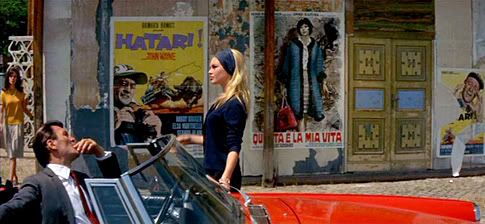
It’s even a bit comical, actually, as is much of the film. At his best when his directorial manner is easygoing and his tone silly, even while shouldering serious subject matter, Godard here is constantly at play; a short musical theme runs almost ceaselessly throughout, for example, and in the first scene he keeps switching filters arbitrarily, from blue to none to red—foreshadowing the vivid reds to come, on everything from couches and convertibles, blouses and bathmats, to the painted eyes of Greek god statues. (The solemn audience at Film Forum, where the film recently screened, let out nary a chuckle, this writer not included, presumably out of a misguided academic respect for Foreign Film.)

Told in three distinct sections, the romance plays out most fitfully during the second act, a prolonged romantic squabble in which Bardot dances around the issue at hand—the way she has been sold, whether literally or not—and Piccoli dutifully follows suit, disingenuously laboring to discover the root of her sulking as if he doesn’t already know. But acts one and three also go after something act two only hints at, when Piccoli, in a fedora with a cigar between his teeth, admits to consciously modeling his look after Dean Martin’s in Some Came Running—with its back lot/on-location settings and its backstage story, Contempt is about movies.

Part one is set on a movie studio that looks like Roman Ruins, the characters romping on what look like the last vestiges of cinema. The set has been sold and will probably be turned into a five and ten, Palance declares with hilarious histrionics. Godard suggests that the film is set during the end of the cinema; a projection room screen includes a popular Lumiere quote, translated into Italian: “cinema is an invention without a future.” (Despite the posters for Psycho, Hatari! and Godard’s own Vivre Sa Vie slathered on the walls.) Lang famously quips that Cinemascope, in which the film is shot, is only good for capturing snakes and funerals, and so we get a film full of slimy, serpentine characters and a memorial service for the cinema. On the set, after Piccoli asks whether some scantily clad women will undress, he’s told, of course. “Movies are wonderful,” he mutters. But if there’s something unsettling about women being used as objects of desire, as media of exchange (for sex or for translating) or, bent over, as tables on which to write checks, we have no one to blame but ourselves. Movies present “a world in harmony with our desires,” Godard tells us at the very beginning, quoting his teacher Andre Bazin, before turning an on-screen camera at the audience, letting us know that, in his estimation, we’re responsible for the objectionable behavior we see on the screen. “You long for a world like Homer’s,” one character says. “It does not exist.” Not even at the movies.


Watch the trailer:

28 April 2008

Stuff and Dough

Directed by: Cristi Puiu
Written by: Cristi Puiu & Razvan Radulescu
Full Credits from IMDb

Grade: B-


Rarely have I ever taken so few notes during a movie as I did during Stuff and Dough (Marfa si Banii), a maddening exercise in anticlimax that does for the Romanian New Wave what Cars did for Pixar: interrupt the winning streak. After near masterpieces like 12:08 East of Bucharest and 4 Months, 3 Weeks & 2 Days, the film movement manages to disappoint with this (previously unreleased-in-this-country) debut feature, from the director of the heralded The Death of Mr. Lazarescu, that serves as a clear demonstration of how using the ordinary trials of ordinary people as a cinematic device can go so wrong. The film could approach the extraordinary, if it wanted to, as a tense road movie along the lines of Duel or The Wages of Fear, but instead settles as an ambling road trip full of minor conflicts that never quite develop and therefore never quite compel the audience’s attention. It is shot almost entirely from the backseat of a van, focused on the bull sessions, the false boasting and funny stories, between two pals and their female accessory.

Alexandru Papadopol has dreams of moving out of his parents’ house and getting his own food stand, bigger and better than the meager one his folks struggle to operate; so when a nose-picking local man offers him two years’ wages to deliver six packs of “medical supplies” from Contanta to Bucharest, a mere four hour drive, he jumps at the chance. His buddy Dragos Bucur tags along with his latest catch in tow, the nose-picking, Juliette-Lewis-type, Ioana Flora.

Deliver the stuff, get the dough—it sounds so simple and…basically it is. Stuff and Dough feels like it’s about to pick up after a few reels, at least for a moment, but the knuckles quickly unwhiten. The trio runs into trouble when a red jeep asks them to pull over and then attacks without provocation, bashing in the driver’s side window with a bat and smashing Papadopol’s legs in the passenger side door like they were Frank Vincent’s head, but Puiu doesn’t seem interested in sustaining tension; at most, Stuff and Dough is quick bits of foreplay interlaced with downtime. Though the red jeep continues to pop up menacingly from time to time, most elegantly in glimpses from the rear view mirror, the two groups do not confront one another again, and our band of heroes’ apprehension wanes easily. And if they’re not worried, why should we be?

I suppose we’re not supposed to, but if this isn’t a chase movie—as some critics are making it out to be—then what is it? A neorealist slice of life in post-Ceausescu Romania? Behold the Romanian countryside, its highway system, its wholesale markets, and its callow youth? At least the filmmakers use the running time to comment on the state of their motherland, on how the pressures of moving into modernity can tear comrades apart and about how one cruel and corrupt system has simply been replaced by another. Stuff and Dough is reflective and cautionary: young men just clear of their mother’s apron strings, like young nations recently freed from dictatorship, ought to proceed cautiously into their freedom-filled futures, lest they wind up in over their heads—that is, under the control of criminals, gangsters, killers and drug dealers. But to make the point, the filmmakers simply stick a dizzy camera in a car and let the cast shoot the shit. The actors all do an admirable job of achieving effortless authenticity, and the camerawork is at times graceful if shaky, but Stuff and Dough is hardly more compelling than actually driving for four hours through Romania with your friends to deliver a duffel bag of drugs. That is, despite its potential for action and adventure, thrills and chills, it’s pretty mundane. If that’s a rejection of Hollywood cliché, don’t let’s forget that some things become standards because they work so well and that repudiating convention is not a virtue in and of itself.


Watch the red van confrontation scene without subtitles:

Forgetting Sarah Marshall

Directed by: Nicholas Stoller
Written by: Jason Segel
Full Credits from IMDb

Grade: B+

Wouldn’t the state of modern, mainstream, multiplex American cinema be so much stronger if all its generic romantic-comedies were as hilarious and sincere as Forgetting Sarah Marshall? (Its irritating, contemptible ad campaign not withstanding.) With a firm grasp of the workings of seriocomedy, the film (often) succeeds in moving beyond its superficial hilarity because it’s serious but refuses to take itself seriously; usually laughing at itself, it subtly succeeds dramatically, masking its emotion in self-deprecating humor so that it’s heartfelt but rarely sappy. (“I didn’t know it was a comedy,” star Jason Segel says at one point, a possible metamoment, of his show-within-the-movie, “but then someone told me and it really just opened things up.”)

I qualify with “rarely,” however, because unfortunately, with the irrepressibly prolific Judd Apatow producing, the film trips over the same failing that seems to do in most of his films, including that other Apatow gift to a former Freaks and Geeks cast member, Knocked Up: it goes on too long and has too many plot lines to wrap up, often involving secondary and even tertiary couples, that it has to pause the comedy for second-rate drama. But Sarah Marshall has a strength not even Apatow can diminish, the infinitely likable Segel, who also wrote the (presumably much-tinkered-with) script. He not only possesses the natural comic gift common to those in Apatow’s circle, but is able to bring a subtle measure of pathos to the film, best encapsulated by his, ahem, Dracula rock opera with puppets. When Segel sings, in a Count Chocula accent to Jim Steinman-inflected piano music, “if I see Van Helsing, I will slay him,” it’s first and foremost guffaw-worthy; but at the same time it’s also sad, with, absurdly, a bit of pitiable truth.

Though not often featured lately in Apatow productions because studio execs find him excessively strange, Segel has always been one of his most amiable players because he’s so easy to feel bad for. Here, he elicits our sympathy from the first reel when his long-time girlfriend, the eponymous Marshall (Kristen Bell) dumps him in a state of defenselessness, without even a towel to hide [his] behind. (The Simpsons Movie seems to have broken down the wall for full frontal male nudity in American comedies.) A man brandishing his penis on-screen is funny—isn’t it?—but a man butt-naked and weeping is also endearing. (Questionably endearing, however, is Segel’s unhealthy obsession with his own penis, which he twice reveals to the audience in book-ending scenes; he also has his doctor declare, “it’s a good-looking dick, it’s a beautiful dick” and, eventually, he goes so far as to cast it as his moral compass, when it refuses to become erect for a woman he probably ought not be sleeping with.)

When a series of awkward hook-ups prove unfulfilling, the broken-hearted Segel—established as such by his choice of songs, “Nothing Compares 2 U” and “Heaven Knows I’m Miserable Now”—packs it up and heads to Hawaii for a holiday. The archipelago is the perfect post-break-up comic backdrop, with its contrapuntal surfeit of newly weds, engagement proposals and happy couples, but the decision to head for the Pacific seems more motivated from a desire by the pasty Apatow Gang to catch some sun and treat themselves to pastel-colored drinks. (As though, to paraphrase a Simpsons catch phrase, “the freaks and geeks are going to Hawaii!”) It must be nice to be able to procure sizeable Hollywood budgets to indulge your vacation whims. As one character notes, “Hawaii is a place for people to escape, for people who can’t deal with the real world.”

That, in a nutshell, sounds like the prototypical Apatow hero—a manboy who can’t function in the real world, at least not without the love of a good woman to set him straight. In accordance with the tropes of the genre, the length of the film serves as a means for Segel to get to know a nice girl, Mila Kunis, so he can eventually not bed her but make love to, er, with her. The plot may carry a touch of sexism, as A.O. Scott suggests—what with a plethora of fetching lookers fighting to claim a piece of Segel’s schlub so that he may be redeemed—but the relationship is good for Kunis, too. It encourages her to “go back to school”. (Uh, maybe.)

To his credit, Apatow has refined his formula, making it a bit more sophisticated (or, “he has become cautious enough to preempt the brand of criticism that met Knocked Up”), by turning the tables a bit near the end when he exposes the hero, Segel, not as a victim but as a bad boyfriend, a lazy and inattentive lover who got what he had coming. (But then Stoller has to spoil it all by cuing something stupid like a soft guitar riff.) Some couples break up because they can’t grow up if they’re still together, the filmmakers suggest. That’s an interesting twist, adding a measure of complexity to the characters, at least by date movie standards, but is it really necessary? Above all else, Apatow & Co. are naturally hilarious and have the remarkable ability to repeatedly provoke out loud laughter. So the question is, why does Judd see it necessary, time and again, to try and prove his hand as a dramatist? Is it a halfhearted, even condescending nod toward the female demographic, following the American Pie formula for success in which there’s ribald humor for the boys and romance for the girls? Apatow has yet to direct or produce a well-told story, not just a stack of comic set pieces in which his drama runs away with him. He needs to leave more for the (admittedly already crowded) deleted scenes section of the DVD and allow the stories wrap up a bit more quickly, even if it means they wrap up sloppily. (Regardless of its hilarity, even Superbad could have lost a reel or two.) Segel succeeds because he hides his emotions behind his comedy; Apatow ought to follow suit by playing up his comedic strengths, not hiding them behind layers of storytelling that never arises above the level of conventional. If you can’t be Woody Allen, it’s better not even to try.


Watch the (red band) trailer:

23 April 2008

Flight of the Red Balloon

Directed by: Hou Hsiao-Hsien
Written by: Hou Hsiao-Hsien & François Margolin
Full credits from IMDb

Grade: B+

In Flight of the Red Balloon (Le Voyage du Ballon Rouge), Hou Hsiao-Hsien, like many a “foreign” filmmaker before him, abandons any and all clichés of moviemaking—that is, the tried and true conventions of Hollywood storytelling—in favor of something…pure? Simple? Fresh? His manner is gentle—the film begins in silence, and the soft murmurs of traffic slowly fade in—but the end result here is oppressive; set mostly in a cramped and cluttered apartment or in the narrow, shaded streets of Paris, Red Balloon largely keeps us tethered to the quotidian, making the audience feel like its star, the vividly frazzled, strung-out-on-stress Juliette Binoche. From an early shot through a moving subway train’s windshield, Hou informs us that, in today’s hectic world, Westerners are always, exhaustingly, pushing forward.

But, in contrast, he digs out life’s balloonality, the occasional, floatingly graceful respites from the taxing everyday: playing pinball in a café, collecting newspapers and empty bottles from an apartment floor, grabbing brass rings while riding a carousel horse. Captured through Hou’s lens, these small moments take on a nimble, empyrean elegance, one paralleled by the film’s titular red balloon. In contrast to the perpetually plowing ahead Binoche, the too-infrequently featured, free flying balloon floats upward and bobs back and forth. It is a piece of Eastern enlightenment that, like Hou, has drifted across the Urals into France. In the hands of a lesser director, shots of a floating balloon could fall into pretension, a la American Beauty’s “beautiful” plastic bag, or, even worse, it could be voiced by Eddie Murphy. In Hou’s hands, however, it really might be the most beautiful thing in Paris—his version of it anyway.

Flight of the Red Balloon is a self-described homage to, rather than a remake of, the French children’s-classic. It is a slice of life, sans much of a narrative arc, the story of single-mother Binoche as she takes puppetry lessons and raises her sweet son Simon Iteanu, with the help of immigrant nanny Song Fang, whose French, like mine, extends little beyond a polite “d’accord”. (As an Asian transplant and a filmmaker with a thing for red balloons—and Lamorisse’s film—she clearly seems a stand-in for Hou.)

Throughout the film, Hou places an emphasis on shadows—the balloon’s, the carousel horses’, Iteanu’s sisters’. His film is a contrast of light and dark, of East and West, of happiness and sadness, best represented in a serendipitously discovered painting in the Musée d'Orsay, awash in accidental symbolism, of a boy chasing a red balloon, his parents only visible in the far distance. (The film was commissioned by the museum, whose one requirement was that a scene be set there.) Bionche loves her son, but she’s a frantically upending presence, persistently panting and constantly disrupting the calm tableau of domesticity that Song has constructed for Iteanu, invading her Eastern tranquility with her Western neuroticism.

Binoche usually seems dissociated from her son’s life; when her friend asks Iteanu where she is, he replies, “probably tied up with her puppets.” At one point, she is yelling at, presumably, the boy’s father. “There’s no one beside me!” she shouts. “What about me?” the boy asks. (Hou, to his credit, plays out that last exchange quasi-comically.) So when the balloon hangs in the family’s flat’s window, watching the boy and his nanny prepare crepes, it seems to directly parallel an earlier scene of Binoche spying on her son and daughter playing in their living room. And then the first scene makes sense: Iteanu tries to coax the balloon down to his level, but it refuses and he gives up. It is a rejection from Hou to surrender his film’s ability to literally rise above the mundane, but also a rejection of the boy by his mother.

The balloon, then, is Binoche, or the balloon is God, the balloon is the viewer; all three might be true, specifically, but that’s too literal, an imposition of the prosaic onto the poetic; in a more general sense, the balloon is a merely a touch of the ethereal, so close and yet, with the characters’ heads so low to the ground, always just out of reach. It also functions as a means of cultural exchange, the object that allows Hou, the foreigner, to invade the West with his particular brand of meditative filmmaking. Too bad that style of filmmaking just doesn’t quite translate. In its own way, Flight of the Red Balloon is as exhausting in its languor as the febrile culture Hou seems to criticize.


Watch the trailer:

16 April 2008

The Ruins

Directed by: Carter Smith
Written by: Scott B. Smith
Full credits from IMDb

Grade: B-

The Ruins ought to satisfy anyone (i.e. me, a few nights ago) jonesing for a horror movie, but that’s not to condone it; while commendably maintaining a palpable sense of discomfort, the filmmakers forget the most important thing in scary movies, the thing that made recent entries like Wolf Creek or Cloverfield so effective: recognizable and sympathetic characters.

An Anton Yelchin look-and-sound-a-like (Jonathan Tucker) and his girlfriend, a Jena Malone look-a-like—oh wait, that is Jena Malone—play turistas on holiday down Mexico way, along with their equally vanilla pals, Shawn Ashmore and Laura Ramsey. On the ill-considered advice of a German tourist—with the Hostel films, the bad advice of Europeans is becoming a horror movie convention—they travel to the off-the-beaten-path (in trailerspeak) ruins of a Mayan temple. Once there, savage natives start shouting at them—and not, to the dismay of our pidgin-tongued heroes, in Spanish—and drive them to the top of the temple, where they remain captive for the rest of the movie.

As horror movie filmmakers go, the Smiths display a measure of chutzpah: they not only lock their film into one location—not easy to pull off—but they keep nearly all of their characters alive almost to the very end, refusing to indulge the built-in demographic’s splatterlust. (Though at times the film is a bit gruesomely procedural, obligingly slipping into torture porn along the lines of “we’ll break your bones with a rock, then cut your legs off with a hunting knife and cauterize the stumps with a hot frying pan.”) The tense and terse storytelling—no extraneous subplots, no wasted time—that lets the filmmakers get away with the shortage of settings leaves little space for character, though. Tucker in particular, a stony C-lister, is a major drag on the film, offering, for example, little verisimilitude to the overt expository dialogue, eg. “each of us needs half a gallon of water a day to survive”; he certainly doesn’t possess the ability to create a credible character. (Malone, on the other hand, does a fine job; I don’t know whether to celebrate her for raising this film up a notch or scold her for wasting her time.) The filmmakers still manage to keep the film bopping along; unfortunately, however, they run out of steam and rush through the requisite slaughter/denouement, as though another group of filmmakers needed to use the set.


We are left of course with our last woman standing, although Smith defies convention a bit by making her anything but virtuous and sober; whereas horror films usually function as a means of punishing promiscuous teens, our redeemed survivor here is a heavy drinker (she spends the film hungover) and an infidelious girlfriend. The filmmakers are up to something other than giving our arrogant American heroes their comeuppance. (“This doesn’t happen!” Tucker tells his friends. “Four Americans on a vacation don’t just disappear!”) Our straight man, a med student, sacrifices himself for the team; the Smiths display a conservative bent here, showing little pity or clemency for the resident man of science and his complicit pals. (They gleefully offer a close-up of his dead body.) In The Ruins, the Native American savages, not without a method to their madness, serve only as secondary villains; our protagonists’ central nemesis is Mother Earth and its carnivorous vegetation. (Whose leaves bear a conspicuous resemblance to those of the marijuana plant.) The Ruins makes a point to remind us, along with every hurricane season, that nature isn’t exactly our friend. But the marketing team took it one step further. “Terror has evolved,” the movie poster’s tagline reads. Apparently our greatest enemy is evolution itself.


Watch the (red band) trailer: