Mishmashing myriad influences — Cassavetes, Godard, Bujalski, Woody Allen, Astaire-Rogers — writer-director-editor-lyricist Chazelle fashions something new: the first Mumblecore Musical. It’s a black-and-white, naturalistic, 16mm exploration of young people and their romantic affairs that plays out on Boston streets and in apartments. But instead of awkwardly stammering their way around What They Mean, Guy (Jason Palmer) and Madeline (Desiree Garcia), respectively, play the trumpet and spontaneously slip into song. It’s affecting, endearing, and, even better, toe-tapping.
Tyson opens with a bird’s-eye shot of a boxing ring, suggesting that the film to follow might be a judgment of the titular mortal, through a lens godly. No such luck — not godly, just Tobackly. This straightforward, apotheosizing biodoc is too ensorcelled by its subject to take the cold, distanced or objective view. It plays out instead as one long fawning interview; writer-director Toback sets his camera in front of the scary, now-face-tattooed pugilist and lets him spill his compelling story as he sees it: the childhood bullying and heavyweight championships; the marriages and rape scandal; the Buster Douglas fight and, um, the Holyfield ear…incident.
Like the award-losing Benjamin Button, Is Anybody There? is an intermittently poignant movie obsessed with death. And, unlike that Pitt-lead dourfest, it’s intermittently funny, too! Set in an independently run nursing home, a ramshackley mom-and-pop start-up, the movie charts the budding friendship between a young boy (Son of Rambow’s Bill Milner, easily confused with Freddie Highmore), son of the caretakers, and a retired magician (Michael Caine), a new resident. That’s a dangerously contrived set-up treading in perilously manipulative waters, but the the strength of the leads manages to sustain a sweet tone while, most of the time, keeping clear of cloying.
The movie plays out as a study of two disagreeable and frequently unlikable characters—Grumpy Old (and Young) Men—that share a macabre preoccupation with mortality: gloomy gramps is in perpetual mourning for his dead wife; the kid obsesses over the paranormal, trying to record ghosts on tape. (“Why are you so bloody morbid?” the father asks his son. “’Cos I live here!” he answers.) The actors vivify each, particularly Caine, who adds complexity to a tired archetype, the old timer resentful to be placed in a care facility. Unshaven, uncombed and bloodshot, like an Irish sea-captain back from an Odyssean voyage, he seethes and snaps at the kind or aloof people around him. Caine humanizes the crusty fogey: cutting in one moment, he weeps in the next.
Unfortunately, the film doesn’t live up to the performances. Director Crowley, who deftly staged The Pillowman on Broadway, directs Is Anybody There? like a theater man, even though his resume boasts more film credits (e.g. the well-received Boy A). Most glaringly, he has little faith in his images, drowning them in thick and nauseous musical syrup. Script problems drag him down, as well; he muddles through a misguided subplot about the nursing home proprietor—the boy’s father—lusting after the hired help, and the screenplay relies on unconvincingly quick changes of heart, as if a reel were missing.
Still, at the least, Is Anybody There? feels like a fresh take on the kooky old folk routine. Writer Harness grew up in a situation similar to that of our young protagonist, so he and Crowley imbue the movie with seemingly authentic details. For every contrived moment of quirkiness—the post-stroke geezer who can only mutter a single word—there’s a moment of genuine pathos, whether it’s Caine weeping in the mirror as he calls his departed beloved’s name, or an ancillary old woman sobbing in the corner of the frame. That it’s British doesn’t hurt—prick jokes told to priests replace rapping grannies—and it helps, too, that the film boasts a master thespian at the top of his game. If Caine were as sick as his character appears, this would be a worthy performance to go out on, regardless of the iffy material that it supports. Grade: B-
Sleep Dealer grapples with the Latino immigrant experience. Before you click away in been-there boredom, know that it does so by harnessing the batty tropes of science fiction: It sets its protagonist, an itinerant laborer, within a dystopian, technocratic, Philip K. Dickian near future in which a war over water rights, pitting freedom fighters against corporations and the governments that love them, has devastated the Mexican economy. The recent Sugar, which cloaks its immigrant story in the trappings of a neorealist baseball movie, might handle more effectively the bleak reality of the migrant workhorse. But Sleep Dealer is a hell of a lot more entertaining.
Alien Trespass, a bland, dippy and aggressively kitschy homage to the Hollywood space invasion picture, concerns a broad group of mid-century, small-town American archetypes: the sheriff, the waitress, the yokel, the drunk, the greaser, the high school student, his sweetheart, and, uh, the scientist—an astronomer (played wittily by Eric McCormack, Will & Grace’s eponymous Will). Soon into the picture, a crash-landed alien possesses the scientist’s body; together, he and the townsfolk battle, or at least get eaten by, a different outer space invader: an insatiable, rapidly multiplying creature (with camouflaging capabilities) that reduces humans and animals to steaming puddles of what looks a lot like shit and piss—the joke being, presumably, that ‘50s Americans, fed on thick steaks, tobacco and pie, trigger instant diarrhea in intergalactic beasts.
The monster also happens to look like a veiny, six-foot dildo. In a late scene, that resemblance briefly suggests something about ‘60s sex-craziness encroaching on the squeaky clean ‘50s, threatening women and children. (Don’t worry—they send that superphallus back to San Francisco, or whatever Sodom from which it came!) But the sexual allegory doesn’t carry through the film; it seems accidental. Directed by R.W. Goodwin, a producer (and writer-director) on The X-Files, Alien Trespass desperately, almost pitifully, wants to be cheap and cheesy ‘50s sci-fi camp. And, superficially, the pieces are all there: the conspicuously artificial sets, the ominous music and the exaggerated acting styles, as well as the props—tobacco pipes, tortoiseshell glasses, typewriters and separate beds—and the dialogue: “Cool it, Dickie, it’s his job to suck eggs.”
But where’s the substance? The classics that the filmmakers ape—such as It Came from Outer Space and The Day the Earth Stood Still—were deeply political films, cold war allegories that leaned both left and right. This film doesn’t lean at all; without any driving ideas, it’s all apolitical surfaces, a Technicolor photocopy pastiching pastiche. It fetishizes not the 1950’s but its empty pop culture signifiers. And as such, it doesn’t just signify nothing—it’s insignificant.
Directing duo Ryan Fleck and Anna Boden look like they’re on a quest to reinvent American subgenres. As well they should be: too many of this country’s movies, not least of all its indies, have languished too long under the insistent predictability of their narrative and character arcs. Every so often, they need a good shaking up. The directors’ mission began three years ago with Half Nelson, which, years before The Class hit these shores, made the student-teacher movie feel fresh, even stimulating. Rejecting the phony inspirationalism of exemplars like Dangerous Minds and Freedom Writers, it flipped the familiar formula: Ryan Gosling’s antiheroic, crack-addicted history teacher needed salvation as much as his inner-city students did; he leaned on them.
Fleck and Boden, who remain a team since they met and began dating as NYU film majors, now return with Sugar, a baseball movie that, like Half Nelson, bears only a cursory resemblance to its generic forebears.
Directed by: Majid Majidi Written by: Mehran Kashani & Majid Majidi Full credits from IMDb
Grade: 3/5
The Song of Sparrows, a serio-charming slice of Iranian neo-realism, shrouds grave matters like despondence and destitution in the trappings of a culture-contrast comedy. Concealing social criticism to curtail the censors is by now standard operating procedure in Iran. And so, for a while, the film plays its desperation for laughs. Karim (the hard-scrabble-faced Reza Najie) works at an ostrich farm, an inherently hilarious location thanks to the creatures’ rubber golf club neck-and-head combos. Director Majid Majidi exploits the setting for a few comic set pieces: a gaggle of workers scrambling after a runaway ostrich; Karim hunting that escapee in the desert, bent over, clad in a cape of ostrich feathers, brandishing an ersatz ostrich neck-head made of wood. But beneath the ostensibly laughable bubbles something more serious: Karim is poor, living in an impoverished (yet quasi-Edenic) village, and he has a wife and three children to support, one of whom is almost as deaf as a post and in need of a new hearing aid. A lost ostrich translates into a lost job, which he can’t afford. Soon, the shots of ostriches shed their risibility and assume a taunting and contemptible air.
Paul Dano looks weird. With his planar forehead, nubby chin, and inward-sloping face, he resembles a living Daniel Clowes drawing. Naturally, then, he's often cast in oddball roles, like the Nietzschean mealy-mouth of Little Miss Sunshine, the character he channels most in Gigantic. (Rather than, unfortunately, the superiorly seething and serpentine preacher of There Will Be Blood.)
The press notes provided very little information about the filmmakers, so I'll speculate: I imagine they were raised in a bona fide Squaresville, U.S.A., where cheerleaders and football players told them they were strange and they eventually came to believe it, to define themselves proudly by it. So now they've made this, a movie about eccentrics whose sole function is to be eccentric because, in a romantic Sundancer like this, being eccentric is a virtue in and of itself—old bullies be damned.
Directed by: Rob Letterman and Conrad Vernon Written by: Maya Forbes, Wallace Wolodarsky, Rob Letterman, Jonathan Aibel and Glenn Berger Full credits from IMDb
Monsters vs. Aliens turns on that old narrative cliché about using bad guys to battle even worse guys. Sometimes...it takes a thief to catch a thief. That's what those pre-Hannibal Hannibal Lecter stories are about; also, Ghostbusters. Most of all, though, this film reminded me of The Incredibles — just stripped of all the humor (not even the kids were laughing, just the doofus dad behind me), big ideas, and character development, leaving behind the action set pieces designed to be the levels in the requisite video game — which the Pixar film had in unfortunate abundance, too. Sometimes I feel like I'm playing the movie, a sensation bolstered a bit by the 3D.
Keep reading my discussion with Benjamin Sutton on The L Magazine blog.
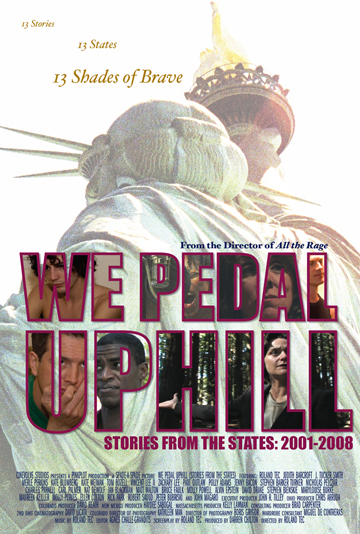
We Pedal Uphill collects 13 vignettes—one for each red and white stripe—about life in these Disunited States, from 2001–2008. Each story, set in a different state, from Massachusetts to Oklahoma, is a Bush-era tale of fear, racism, homophobia, corruption and treason. Conspicuously, it’s a low-budget labor of outrage, so we can forgive the theatrical acting styles, even the earnestness of its lefty politics. But it’s harder to forgive the film’s timing; it has arrived too late.
Like the upcoming exercise in sci-fi camp, Alien Trespass, The Perfect Sleep is an empty homage to a bygone genre. Several genres, in fact: It's a kung-fu noir with a modern machine-gun mobster movie twist. If that sounds like fun, it's not.) Writer Anton Pardoe stars as the Narrator, a snide mutterer who has come back to town after a decade or so in exile to clean up a lifetime's worth of messes in a matter of hours; many people with exotic names have to die for reasons that are unclear, or at least unconvincing. Too frequently, I had little idea what was happening or who certain characters were, but the gist seems to be something about the children of enemy gangsters who have grown up to be enemy gangster-types themselves, with a heap of mommy and daddy issues to work out.
Directed by Pierre Morel Written by Luc Besson & Robert Mark Kamen Full credits from IMDb
Taken is a knuckleheaded action movie about kidnapping and sex slavery. Or, Taken is a subversive thriller about girls gone wild and American hegemony. Or, both. Channeling Ra's Al Ghul more than Oskar Schindler, Liam Neeson plays a retired kung fu spook who infantilizes his 17-year-old daughter: he dozes off watching home movies of her fifth birthday party; he orders her milkshakes with—wait for it—extra cherries. (!!!) So he’s reluctant to let her leave the country because he knows first hand how dangerous the world is for young women. In an early scene, moonlighting as a security guard, he saves the life of a Shakira-esque singer, disarming (with his bare hands) a backstage assassin wielding a phallic knife.
Who’s next? Tout de France! His daughter (Maggie Grace, slightly less insufferable here than on Lost) wants to stay in Paris for the summer, but he’s uneasy about allowing her to leave the manufactured safety of America. For good reason, too—sex traffickers move in on her the minute, literally, she steps foot out of Charles de Gaulle. That is, the moment she leaves home, she starts doing drugs and doing dudes. From his perspective, she’s your typical American coed—but not if he can help it. The abduction scene is suspenseful, the work of a true movie craftsman; if nothing else, Taken is expertly paced, smartly sticking exclusively to the fists-and-fury Neeson once the story properly begins. But as a result, it feels absurdly plotted. (Really, she can’t get further than the taxi stand?) It turns out, though, that that preposterousness is not a weakness we must forgive or overlook; instead, it serves as a clue: what you’re seeing on-screen is meant as a joke. Taken has a subtle satirical underside.
Neeson, in full-on glower mode for most of the film, is a parody, how the mostly French filmmakers imagine that Americans see themselves. If he has to, to save his spawn, he “will tear down the Eiffel Tower.” He nearly does, leaving a trail of dead bodies, traffic jams and property damage in his wake as he rips through makeshift hovels filled with doped-up sex slaves, engaging in gun fights and car chases. (He still finds time to pause and criticize arrogant Albanian immigrants for taking advantage of a tolerant French system.) Arrests are for pussies, i.e. Euros—everybody dies, and there’s no pity for the dead. A young white woman’s virginity is at stake! In fairness, it’s almost impossible to fault Neeson: the men he kills are (indirectly) raping his fucking daughter. Should he write a strongly worded letter to the consulate?
But that’s a part of the gag: his unassailable rectitude feels like an exaggerated view of our Bush-era selves, viewed through a glass Frenchly. Americans, of course, only fight just battles overseas, fully cloaked in the black-and-white righteousness of the red-white-and-blue flag. At one point, Neeson shoots an innocent woman just to make a point, and it’s here that he gets harder to like. He becomes out of control, a symbol of unchecked American power run rampant “over there”. The filmmakers go farther still: Once he unravels the sex trade conspiracy, he discovers not only the complicity of one of our allies’ governments (though not a member of the coalition of the willing, of course), he finds an American at the center of the ring, judging from the man’s accent, who lectures Neeson on the supremacy of money and business. This is a ballsy detail for multiplex fare: the Americans’ true enemy is not only capitalism—it’s themselves. Grade: B+

 Mishmashing myriad influences — Cassavetes, Godard, Bujalski, Woody Allen, Astaire-Rogers — writer-director-editor-lyricist Chazelle fashions something new: the first Mumblecore Musical. It’s a black-and-white, naturalistic, 16mm exploration of young people and their romantic affairs that plays out on Boston streets and in apartments. But instead of awkwardly stammering their way around What They Mean, Guy (Jason Palmer) and Madeline (Desiree Garcia), respectively, play the trumpet and spontaneously slip into song. It’s affecting, endearing, and, even better, toe-tapping.